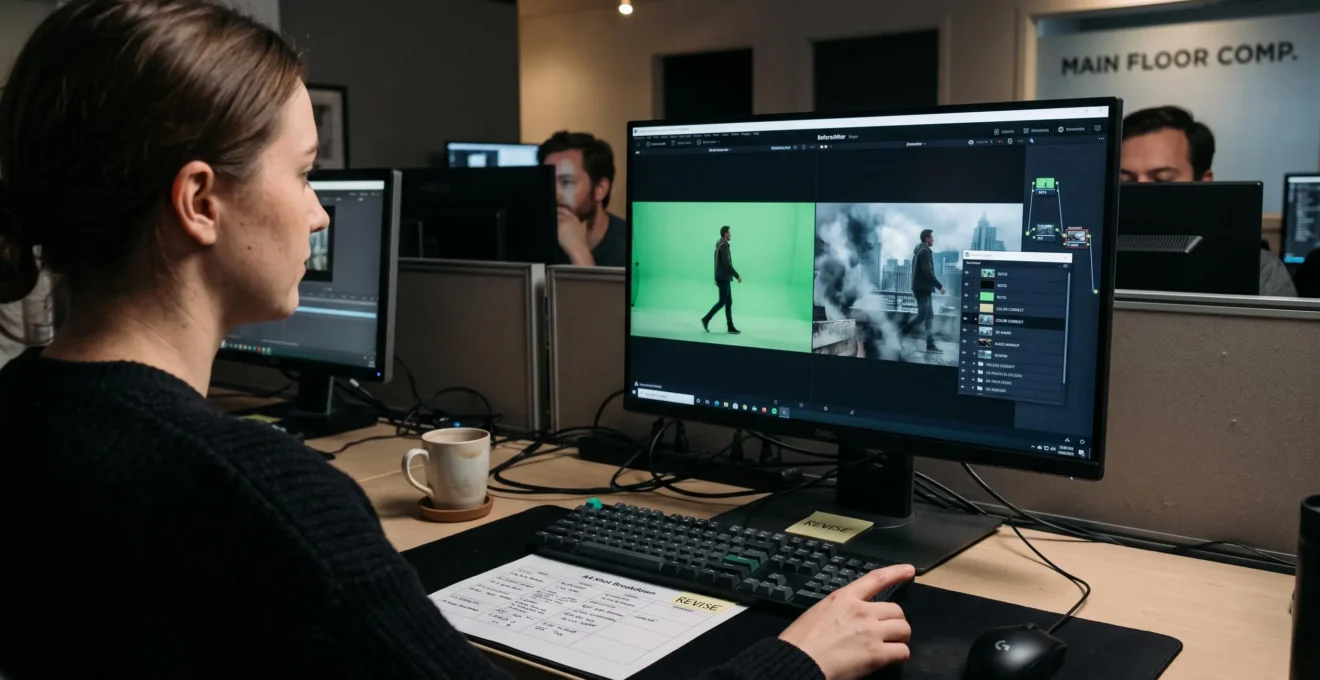
A studio-ready Vancouver VFX reel makes three things immediately clear: the position an artist wants, the quality of work they can deliver, and their exact contribution to each shot. Within the opening 60 seconds, a reviewer should be able to identify the candidate’s strongest discipline, inspect meaningful technical evidence, and understand whether the work matches an available production role.
That does not mean every reel must last exactly one minute. The opening minute is a useful presentation target, not an established Vancouver hiring rule. Depending on the discipline and employer instructions, a longer reel with appropriately detailed breakdowns may be more effective.
British Columbia supports film, television, animation, VFX, and post-production activity, but individual studios recruit for different production needs. A polished montage alone cannot demonstrate that a compositor understands plate integration or that a game artist can optimize an asset for real-time use. Effective applications connect visible results to production responsibilities.
For artists receiving rejections despite technically impressive work, the most useful starting point is not necessarily creating another shot. It is making existing evidence easier to evaluate.
What makes a Vancouver VFX reel studio-ready?
- Show the strongest role-relevant work first, with specific credits and clear breakdowns.
- Use the opening 60 seconds to establish technical competence, not to imitate a social-media highlight montage.
- Align the reel, portfolio page, and application with the same target discipline and demonstrate appropriate production constraints.
- Why Do Vancouver VFX Teams Reject Reels That Look « Good » on Instagram?
- How to Recut Your VFX Reel in 90 Minutes to Match Vancouver Studio Review Habits?
- Generalist or Specialist: Which VFX Positioning Gets More Vancouver Interviews After 3 Rejections?
- The Credit-Listing Mistake That Can Get a Vancouver VFX Applicant Blacklisted
- When Should Vancouver VFX Artists Apply to Avoid Competing With 100 New Grads at Once?
- How to Build a Vancouver-Ready Digital Portfolio in 2 Hours Using One Free Website Tool?
- Why Do Vancouver Game Studios Care More About Playable Proof Than Beautiful Art?
- Which 3 Portfolio Pieces Make Vancouver Hiring Managers Trust You in Under 90 Seconds?
Why Do Vancouver VFX Teams Reject Reels That Look « Good » on Instagram?
A visually impressive Instagram reel can underperform in a Vancouver VFX application because it hides the evidence needed to assess production skills. Fast cuts, dramatic music, and finished images may attract attention without revealing the applicant’s actual responsibilities. For a studio review, role clarity, shot breakdowns, and relevance usually provide more useful information than presentation effects.
The distinction is between a highlight reel and a production-focused showreel. Social-media editing rewards immediate visual impact. Studio evaluation needs to establish whether an artist can perform a defined task within a collaborative workflow.
A compositor’s beautiful final image might contain contributions from lighting, FX, animation, and environment departments. Without explanation, the reviewer cannot determine whether the candidate integrated live-action plates, performed cleanup, handled keying, adjusted atmospheric elements, or simply assembled supplied layers.
The ScreenSkills guidance on building a VFX portfolio recommends demonstrating production processes through shot breakdowns, identifying software, and explaining individual contributions. This is professional guidance applicable to Vancouver applications, not evidence of a standardized review procedure across local studios.
For each shot, use a consistent identification format:
- Discipline: compositing, lighting, FX, roto, prep, or another relevant specialty.
- Contribution: the exact elements personally created, modified, or integrated.
- Tools: software genuinely used for the documented work.
- Evidence: a plate comparison, pass breakdown, layer progression, or appropriate technical view.
Consider a hypothetical compositor showing a final cinematic explosion. The final image alone does not distinguish an FX simulation artist from a compositor. A labeled progression showing the original plate, supplied FX element, integration work, and final composite makes that distinction visible.
| Element | Social-media cut | Studio-review cut |
|---|---|---|
| Editing | Rapid transitions and short visual highlights | Sufficient viewing time to inspect each relevant shot |
| Framing | Vertical crop optimized for mobile feeds | Framing that preserves composition and technical detail |
| Audio | Music drives pacing | Visual evidence remains understandable without audio |
| Credits | Often minimal | Specific contribution, role, and tools are identified |
| Breakdown | Optional process content | Process evidence where it supports the target role |
The practical solution is to maintain separate social and studio-review versions when both audiences matter. The two edits may reuse authorized material, but each should suit its intended viewer.
Run a five-second clarity test on each opening shot: play the reel muted at normal speed and ask whether a reviewer could identify your discipline and contribution from the available labels and images. Five seconds is a useful self-imposed diagnostic, not a documented universal screening interval.
If your strongest shot is impressive but impossible to attribute, the immediate improvement is clearer evidence. Once the problem is identified, the next task is cutting a reel that delivers that evidence without unnecessary footage.
How to Recut Your VFX Reel in 90 Minutes to Match Vancouver Studio Review Habits?
A Vancouver-focused VFX reel can be substantially improved during a structured 90-minute editing session by selecting relevant shots, placing the strongest first, adding concise technical evidence, and checking credits. This is a practical editing exercise, not an industry-standard time limit. The goal is to make the reel correspond to one actual job description rather than every possible VFX position.
Start with the job posting. Identify its principal discipline, required software, typical tasks, and desired production experience. Then compare each existing shot against those requirements.
Use a simple decision grid rather than deciding which shots to retain solely by visual attractiveness.
| Portfolio shot | Job requirement demonstrated | Editing decision |
|---|---|---|
| Live-action keying and integration | Keying, edge treatment, plate matching | Keep and lead with it |
| Complex cleanup sequence | Paint, prep, continuity | Keep with before/after |
| Stylized animation | No clear match to the selected comp role | Remove from this application |
| CG integration shot | Multipass compositing and integration | Keep with contribution label |
The four-to-six-shot target is a useful starting point for this editing exercise, not a universal optimum. Preserve additional material when it provides necessary evidence and stays relevant.
Organize the editing session into five deliverables. Allocate more time to selection than cosmetic transitions: poor shot choices cannot be rescued through elegant editing.
90-minute reel recut checklist
- Minutes 0–15: extract the target job’s discipline, tools, and responsibilities into a short requirement list. Deliverable: a one-page role-matching grid.
- Minutes 15–35: select four to six relevant shots where appropriate, remove distracting material, and order the strongest evidence first. Deliverable: a revised editing timeline.
- Minutes 35–60: add before/after or split-screen evidence for the two strongest suitable shots, identifying the actual work performed. Deliverable: two readable technical breakdowns.
- Minutes 60–75: add accurate shot titles, individual contribution labels, software information, and permitted credits. Deliverable: a consistent set of shot slates.
- Minutes 75–90: export, review without sound, test playback, and verify the contact details. Deliverable: a working reel file or review link ready for application.
For collaborative production work, a credit line could read: “Compositing — keying, edge integration, atmospheric matching; supplied CG and FX elements.” Add project and supervisor information only when accurate, authorized, and relevant.
Never include unreleased studio footage merely because it would improve the reel. If permissions are unavailable, use clearly labeled personal projects, original CG work, or otherwise authorized material. A weaker-looking but legitimate demonstration is preferable to breaching a confidentiality obligation.
Once the sequence communicates a recognizable skill, its positioning becomes easier to evaluate. Repeated rejections may indicate that the applicant is targeting the wrong kind of position, rather than that the editing itself is inadequate.
Generalist or Specialist: Which VFX Positioning Gets More Vancouver Interviews After 3 Rejections?
Specialist positioning is often the clearer starting strategy for an artist applying to a defined Vancouver VFX department, while a generalist reel can be appropriate for broader roles. Three rejections alone cannot prove which approach generates more interviews. The useful response is to examine whether the target jobs require one discipline or a combination of responsibilities.
In a department-based production workflow, an applicant for a compositing position needs evidence of compositing competence. A reel alternating unrelated modeling, animation, FX, and editing shots may make it difficult to assess that competence consistently.
Smaller teams, previs environments, virtual production, and mixed-responsibility positions can instead benefit from artists who demonstrate a combination of capabilities. The deciding factor is the actual scope of the advertised job, not a blanket belief that Vancouver employers prefer specialists.
| Application context | Specialist positioning | Generalist positioning |
|---|---|---|
| Dedicated compositing vacancy | Lead with compositing evidence | Show adjacent skills only where useful |
| Dedicated lighting vacancy | Prioritize lighting and rendering decisions | Avoid unrelated material obscuring the lighting work |
| Broad CG generalist role | Show a strong primary capability | Demonstrate connected asset-to-shot tasks |
| Previs or mixed-role production | Retain a recognizable strength | Show the multiple responsibilities requested |
For an early-career artist, one disciplined portfolio is often easier to evaluate than a reel asserting equal mastery of many unrelated roles. However, years of experience alone do not determine the right positioning. Existing project evidence and employer requirements matter more.
After three unsuccessful applications, classify the outcomes. Were all three for compositing vacancies? Were they for unrelated departments? Did a reviewer actually see the reel? A rejection without feedback cannot establish the cause, and applicant-tracking systems may filter applications for reasons independent of portfolio quality.
A hybrid reel is another option: reserve approximately the first 60–70% for the primary specialization, then include one or two relevant adjacent-skill demonstrations. This ratio is an editorial template, not a proven hiring formula.
For example, a prep artist moving toward compositing could open with cleanup and plate-reconstruction work before demonstrating basic integration. That makes the career direction credible while preserving evidence of an established skill.
Be careful with overly narrow positioning. Building expertise only around a single repetitive task may restrict opportunities if tools, automation, or production workflows change. A strong primary specialty supported by adjacent skills creates a more adaptable professional profile.
The positioning should then be reinforced by accurate credits. A clearly defined specialty loses credibility when the applicant’s listed contribution does not match what they actually produced.
The Credit-Listing Mistake That Can Get a Vancouver VFX Applicant Blacklisted
The most serious VFX reel-credit mistake is claiming work that another artist or team performed. Misleading attribution can undermine an applicant’s credibility, especially when employers seek references or verify experience. However, there is no evidence that a single incorrect credit automatically causes industry-wide blacklisting in Vancouver. The practical requirement is precise, verifiable attribution.
Production shots are collaborative. A final image may incorporate animation, environments, simulation, lighting, compositing, editorial decisions, and supervision. Being credited on a production does not mean an artist personally created every visible component of a shot.
Three kinds of attribution problems deserve attention:
- Deliberate inflation: claiming responsibility for a shot, sequence, or department task the applicant did not perform.
- Accidental overstatement: describing an entire team deliverable as an individual creation without clarifying the artist’s contribution.
- Ambiguous credits: saying “worked on this shot” when the involvement was limited to a test, support asset, or material excluded from the final version.
The remedy is contribution-level wording. “Compositing: screen replacement, reflection cleanup, and grain integration” provides more useful evidence than “Created the entire sequence.” Similarly, “FX simulation test for an unreleased project” must not be presented as a final production shot if that would be inaccurate or unauthorized.
Credit databases and public project listings may help establish whether someone was associated with a production, but they are not complete records of individual shot responsibilities. A missing public credit does not itself prove that an artist did not contribute.
Before applying, audit every shot against three questions: Was the work genuinely performed by the applicant? Is the description technically accurate? Does the applicant have permission to disclose and display the material?
Contractual authorization and confidentiality restrictions are separate from personal authorship. Even an artist who created a particular effect may not have the right to publish it. Written authorization or an applicable studio reel policy is stronger evidence than assumptions based on public release.
Where verification is possible, maintain a private record of project names, permitted reel material, specific contributions, and relevant contact or authorization details. Do not disclose confidential production information merely to strengthen an application.
Recruiters often cannot explain every rejected application, but that should not be interpreted as evidence of a hidden blacklist. Credit errors are worth correcting because they introduce an avoidable credibility risk regardless of whether a particular employer investigates them.
Once your reel is both technically persuasive and accurately attributed, application timing becomes a separate strategic consideration. The question is when relevant positions actually become available, not simply when competitors are most visible.
When Should Vancouver VFX Artists Apply to Avoid Competing With 100 New Grads at Once?
Vancouver VFX artists should apply when their target studios show genuine hiring activity and their skills match the advertised roles, rather than waiting for an assumed quiet season. Graduation periods may influence applicant competition, but there is no verified universal wave of exactly 100 new graduates. Tracking postings, production developments, and recruitment patterns provides a more dependable scheduling method.
Local education programs and training pathways create new talent entering the market, but their graduation dates, program structures, and application activity vary. Schools such as Lost Boys, Think Tank, and Emily Carr offer useful starting points for researching relevant graduate activity; their schedules should be checked individually rather than treated as one synchronized recruitment cycle.
Production timing matters as well. Film and episodic projects may require different staffing at different stages, and an announcement about a production does not establish when a particular compositing, lighting, or FX department will recruit.
Creative BC‘s motion picture industry overview describes the province’s screen-production sector, including VFX and post-production. Its reporting also illustrates that increased production spending does not necessarily mean more productions are starting. Provincial economic indicators cannot be used as direct counts of Vancouver junior VFX vacancies.
A practical monitoring system is to select a manageable group of target employers and record their published opportunities weekly. For each posting, note the discipline, seniority, required tools, publication date, and whether a similar vacancy reappears.
Over several weeks, this creates a studio-specific recruitment record. A recurring listing may suggest an ongoing need, but it can also reflect reposting practices; neither interpretation should be assumed without further evidence.
| Observed signal | Possible meaning | Practical response |
|---|---|---|
| New vacancy closely matches your specialty | Relevant recruitment opportunity | Apply with a tailored reel when ready |
| Repeated vacancies in one discipline | Possible ongoing demand or reposting | Check employer details and refine positioning |
| Major production announcement | Potential future production activity | Monitor subsequent department-level openings |
| Fewer public postings | Possibly fewer visible opportunities | Maintain targeted outreach without assuming lower competition |
Applying outside heavily discussed graduate periods may reduce exposure to some direct competitors, but fewer advertised positions can offset that advantage. There is no established Vancouver-specific interview-rate comparison supporting a universal best month.
Specialized skills can also change the equation. A relevant FX, lighting, or pipeline demonstration may align with a specific team need even when broader junior recruitment is limited.
Whenever a suitable opening appears, preparation speed matters. An accessible digital portfolio that already matches your reel allows you to respond without rebuilding your entire presentation.
How to Build a Vancouver-Ready Digital Portfolio in 2 Hours Using One Free Website Tool?
A practical Vancouver-ready VFX portfolio can be assembled in approximately two hours using a free portfolio-hosting tool such as ArtStation, provided the shots and permissions are already prepared. Keep the page simple: lead with the target discipline, present three to five strong projects, explain individual contributions, and provide accessible reel and contact links. The two-hour target is a working scaffold, not a guarantee.
For this workflow, ArtStation offers an accessible starting point for hosting creative projects without requiring a custom website. Check current account features and publishing limits before relying on any particular presentation option.
The first 30 minutes should focus on selecting and preparing assets. Export representative previews at practical web resolutions, using formats that preserve sufficient detail without creating unnecessarily large files.
In the next 60 minutes, build the portfolio as a focused sequence. Place the strongest relevant work first, followed by projects that demonstrate process and adjacent competence. A free tool’s default gallery may not provide every desired layout feature, so put essential role information directly into each project’s visible title and description.
Use one repeatable project structure:
- Project title: an accurate description of the sequence or personal project.
- Target role: the discipline demonstrated.
- Personal contribution: specific completed tasks, distinct from team work.
- Software: tools actually used for the project.
- Breakdown: a suitable before/after, pass progression, wireframe, or technical explanation.
Reserve the final 30 minutes for profile and contact details, reel access, and quality checks. Include a clear professional contact method and verify that an employer can reach the relevant project without navigating unrelated pages.
Open the finished portfolio in a private browsing session, on a second browser, and on a mobile device if available. Check that media loads, project descriptions remain readable, and there are no unexpected account or access barriers.
Embedded video behavior deserves attention. Autoplay may be blocked, high-resolution assets may load slowly, and password-protected material may be inaccessible to reviewers. When protection is required, provide the necessary credentials through an appropriate authorized channel.
Visual design should support inspection, not compete with it. A portfolio that resembles an elegant gallery but obscures authorship can be less useful than a plain page showing three clearly documented projects.
For film and television VFX roles, this page can emphasize frame-level work and shot breakdowns. For game-art positions, the evidence needs to extend beyond polished imagery into real-time production considerations.
Why Do Vancouver Game Studios Care More About Playable Proof Than Beautiful Art?
Playable or in-engine proof can strengthen a Vancouver game-art application because it demonstrates that an asset works within a real-time production environment. A beauty render establishes visual quality, but does not necessarily show engine integration, material performance, or optimization decisions. The appropriate evidence depends on the position: not every game-art vacancy requires a playable build.
Game production involves technical constraints that differ from offline film rendering. Geometry complexity, texture budgets, materials, lighting, and level-of-detail decisions can influence runtime performance.
An environment artist might create a visually convincing industrial corridor, but the still image does not reveal whether the asset has sensible UV layouts, suitable materials, practical collision behavior, or appropriate levels of detail for its intended use.
The Epic Games’ Unreal Engine performance guidelines for artists explain how geometry, materials, textures, lighting, and optimization settings influence performance. The linked documentation covers Unreal Engine 4.27; it is technical guidance rather than a universal studio hiring policy.
An effective game-art proof package can combine a beauty view with a recorded in-engine turntable, a small test environment, or a working scene where appropriate. The technical breakdown should document real project decisions instead of presenting arbitrary benchmark numbers.
For example, a hypothetical junior environment artist could present a modular prop set with its source meshes, engine materials, scene placement, and level-of-detail configuration. A short explanation of triangle counts, texture choices, and observed performance would provide context, provided the measurements are genuinely taken from that project.
A downloadable build may be useful when an employer requests interactive evidence. Otherwise, a readily viewable recording and documented engine screenshots may be more accessible than an executable file requiring installation.
For film VFX, the evaluation emphasis may instead be on shot fidelity, compositing quality, integration, and frame-level process. Artists moving between Vancouver screen production and game development should adapt the same underlying work to the destination pipeline rather than sending identical portfolios indiscriminately.
ArtStation Magazine’s 2021 summary of advice from game-industry art directors similarly emphasizes a focused portfolio and an understanding of how the artist’s work fits into production. That guidance supports careful selection but does not establish that a playable artifact always outweighs finished artwork.
Technical demonstrations should still be curated. A reviewer benefits more from a few complementary examples that clearly establish capability than from a large collection where every project communicates the same thing.
Key takeaways before selecting your final portfolio pieces
- A strong final image establishes quality, but an accurate breakdown explains how that quality was achieved.
- The three most important pieces should support one clear professional position rather than compete for attention.
- The reel opening, portfolio landing area, and application should communicate consistent evidence of the same capabilities.
Which 3 Portfolio Pieces Make Vancouver Hiring Managers Trust You in Under 90 Seconds?
Choose three portfolio pieces that demonstrate production-quality execution, a credible technical process, and useful range around your primary specialty. Present the strongest example first, make individual contributions unmistakable, and ensure the three projects reinforce the same job positioning. Ninety seconds is a useful self-test for communication clarity, not a proven Vancouver hiring decision window.
The first piece should be your hero shot: work that most convincingly demonstrates the quality expected for the role. Include its final result and enough before/after context to identify your responsibility.
For a compositor, this could be a challenging live-action integration with clean plate comparison. For a lighting artist, it might be a scene supported by relevant lighting-pass evidence. A game environment artist could present a production-appropriate scene accompanied by its in-engine context.
The second piece should make the process visible. A final image alone cannot demonstrate which technical problems were solved. Layer progression, wireframes, passes, or pipeline explanations help establish the relationship between effort and result.
The third piece should demonstrate range without contradicting your target discipline. A compositor might include a complementary cleanup shot. A lighting artist could demonstrate a different environment or lighting requirement. A game artist could show another asset class supported by engine-integration evidence.
| Portfolio position | Main evidence | Question it should answer |
|---|---|---|
| 1. Hero project | Best role-relevant production-quality result | Can this artist deliver convincing work? |
| 2. Process breakdown | Methods, responsibilities, tools, and technical decisions | Does this artist understand the work? |
| 3. Adjacent capability | A complementary project with credible execution | Can this artist contribute beyond one narrow example? |
The ArtStation Magazine’s portfolio advice from game-industry art directors reports a preference for focused, polished, relevant work over large collections containing unfinished or inconsistent pieces. The article discusses professional advice presented in 2021, not measured hiring outcomes at Vancouver studios.
Test the resulting selection with a colleague or peer. Give them 90 seconds to inspect the three pieces, then ask them to identify your intended role, your principal tools, and your individual contribution. If those answers are unclear, revise the presentation or replace the least informative project.
This test measures the clarity of your evidence rather than whether the viewer has sufficient technical expertise to evaluate all of it. For the final professional review, feedback from someone familiar with the target discipline is especially useful.
Finally, keep the same three projects prominent across all application surfaces. The first shot in the reel should not suggest a completely different career direction from the first project on the portfolio page.
Choose one current vacancy that genuinely matches your skills, arrange the three supporting projects, verify your credits and permissions, and ask a qualified peer to review the result. A studio-ready portfolio is not a promise of an interview; it is a clear, accurate demonstration of the work you can perform.
Does a Vancouver VFX showreel have to be exactly 60 seconds?
No. Sixty seconds is a useful target for establishing role, quality, and contribution quickly, not a universal studio requirement. ScreenSkills provides general professional guidance suggesting reels of around two to three minutes. Follow specific employer instructions and keep all included material relevant.
Can an entry-level VFX artist apply without released studio credits?
Yes. Original personal projects, student work, and authorized collaborations can demonstrate the techniques required for an entry-level position. Label each project accurately and explain the work performed. Avoid presenting student work as commercial production experience or disclosing restricted studio material.
Should Vancouver VFX artists send the same reel to every studio?
A single master collection of authorized work can serve several applications, but its presentation should be adapted when roles differ substantially. A compositing opening should prioritize compositing evidence; a lighting application should foreground lighting responsibilities. Tailoring does not require inventing new experience.
Is a downloadable game build necessary for a Vancouver game-art portfolio?
Not universally. A recorded in-engine demonstration, relevant screenshots, and a documented technical breakdown may show real-time production competence without requiring a downloadable executable. Supply a build when the employer requests one or when interaction is genuinely important to assessing the project.
How should an artist respond to repeated applications with no feedback?
Record the positions targeted, compare required skills against the submitted projects, review credit accuracy, and check whether the reel communicates a consistent specialization. Ask a discipline-relevant peer to critique the presentation. Rejection alone does not reveal whether the problem was the reel, experience level, available vacancies, or another selection factor.