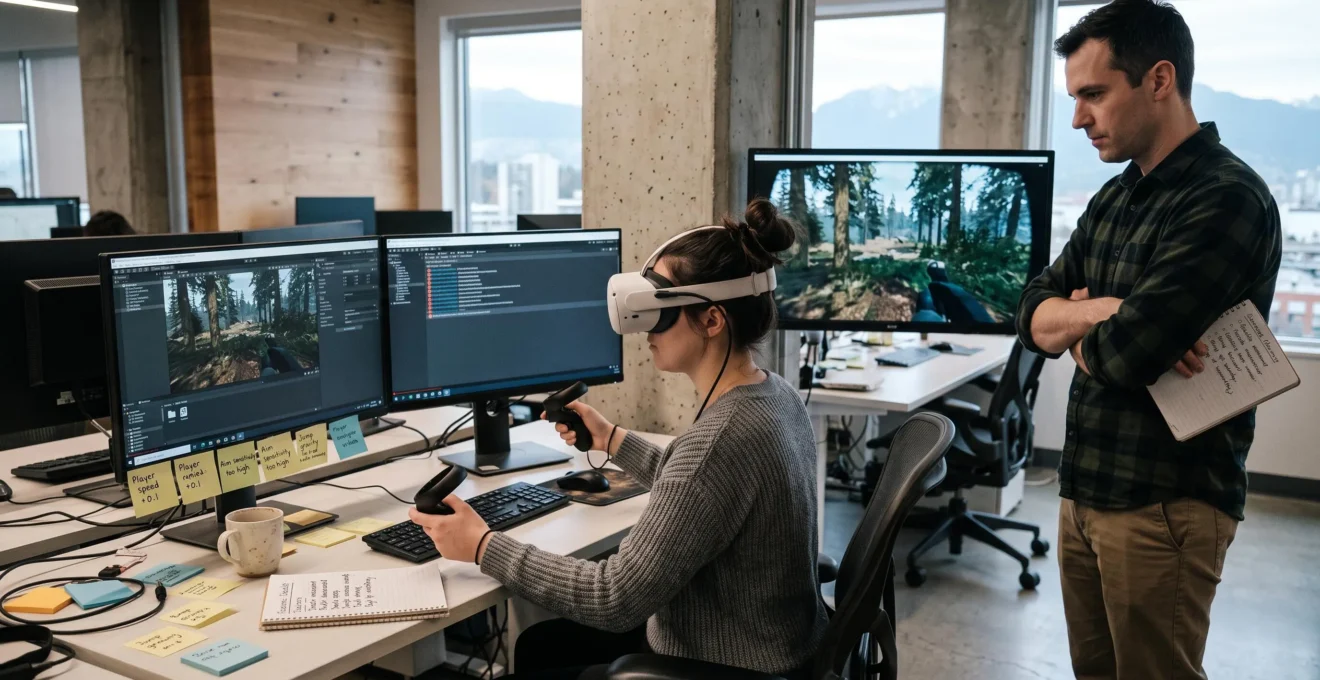
A Vancouver game studio portfolio has one job: make a hiring team confident that its creator can contribute to a production project. Attractive screenshots establish visual ability, but gameplay designers, technical artists and VR developers also need to demonstrate how their work behaves, how they make decisions and how they handle constraints.
That distinction matters when applications generate few responses. A portfolio may contain impressive projects yet leave reviewers unable to identify the candidate’s responsibilities, technical proficiency or contribution to a working game.
The practical solution is not necessarily another large project. It is often a better presentation of existing work: a playable interaction, a concise breakdown, reliable access to the build and an explanation tied to the target position.
For candidates approaching Vancouver’s game and interactive media employers, the strongest strategy combines production evidence with a frictionless review experience. A hiring team should understand what was built, why it matters and what the candidate personally delivered without having to investigate.
What makes a game or VR portfolio worth reviewing?
- Demonstrate production thinking through playable interactions, design decisions and evidence of iteration.
- Make every project immediately understandable, accessible and technically reliable.
- Match portfolio evidence to the target studio’s role requirements, rather than relying on visual polish or application volume alone.
- Why Do Vancouver Game Studios Care More About Playable Proof Than Beautiful Art?
- How to Build a Playable VR Portfolio Demo in 14 Days While Working Full-Time in Vancouver?
- AAA or Indie: Which Vancouver Game Studio Path Builds Your Career Faster After 1 Year?
- The Portfolio QA Mistake That Makes Vancouver Game Recruiters Quit After 30 Seconds
- When Should You Apply to Vancouver Game Studios to Avoid Competing at the Worst Moment?
- How to Build a Vancouver-Ready Digital Portfolio in 2 Hours Using One Free Website Tool?
- Why Do Vancouver Game Studios Care More About Playable Proof Than Beautiful Art?
- How Do Vancouver VFX Artists Make Their Reel Look ‘Studio-Ready’ in 60 Seconds?
Why Do Vancouver Game Studios Care More About Playable Proof Than Beautiful Art?
For gameplay-focused positions, a playable prototype can communicate more relevant information than an attractive image because it reveals how a candidate translates an idea into player interaction. Vancouver game studios need people who can work within production constraints, test decisions and collaborate across disciplines. Visual quality remains important, but it does not establish gameplay design ability by itself.
A compelling render demonstrates composition, materials, lighting and potentially technical art proficiency. A playable sequence can additionally expose input handling, feedback, pacing, balancing and the relationship between player decisions and system responses.
That distinction becomes visible in actual job requirements. An October 2026 EA SPORTS FC gameplay designer job listing in Vancouver describes responsibilities involving gameplay systems, documentation, balancing and collaboration with animation, art, audio, programming and VFX teams.
The posting concerns one experienced-level position, not a universal portfolio screening policy. Nevertheless, its responsibilities provide a useful reference for deciding what a gameplay portfolio should explain.
Consider a hypothetical candidate who has created an impressive combat environment.
The conventional presentation shows cinematic camera movements through the level. A stronger gameplay-oriented presentation adds a 60–90 second interaction in which the player approaches cover, reacts to an enemy cue and makes a tactical choice.
The accompanying breakdown identifies three decisions:
- Which player behaviour the encounter was designed to encourage.
- Which feedback cue initially failed during testing.
- Which value or interaction was changed to improve readability.
The candidate can then discuss the relationship between the original intention, the implemented system and the observed result.
By contrast, a visually striking reel without interaction context may help establish suitability for an environment art position while leaving a gameplay hiring lead with unanswered questions.
This is a question of role relevance, not a universal ranking of art below gameplay. Vancouver employers include large productions and smaller independent teams, but their requirements vary by discipline, project and technical stack.
A gameplay designer should emphasize interactive systems. An environment artist should demonstrate visual craftsmanship alongside engine integration, performance considerations and production constraints.
Start with one existing project and make its production reasoning visible before committing to another portfolio piece. That provides a manageable foundation for building a focused VR demonstration.
How to Build a Playable VR Portfolio Demo in 14 Days While Working Full-Time in Vancouver?
A 14-day VR portfolio demo is feasible as a tightly scoped proof of interaction design, not as a complete commercial experience. Choose one compelling one-minute interaction, establish a working version during the first four days and reserve the remaining time for testing, comfort adjustments and explanation. The schedule assumes focused evening sessions and a substantial weekend work block.
The most common planning error is treating a portfolio prototype like a miniature commercial game. Menus, environments, inventory systems and multiple mechanics create dependencies that consume the time needed for validation.
Instead, define a single **one-minute reveal**: one interaction that shows a recognizable design decision and its consequence.
For example, a hypothetical VR prototype might let players grab an object, assess its weight through visual and interaction feedback, and throw it at a reactive target.
The demonstration needs a clear starting state, working controller input, understandable feedback and a repeatable outcome. It does not need an elaborate narrative or a collection of unrelated mechanics.
The following schedule is a proposed production exercise, not an employer-mandated development standard.
| Days | Main objective | Visible deliverable |
|---|---|---|
| 1–2 | Define the interaction and implement basic input. | One-page scope and working input test. |
| 3–4 | Complete the first playable interaction. | Rough end-to-end prototype. |
| 5–7 | Improve grabbing, physics and feedback. | Repeatable interaction with initial tuning notes. |
| 8–10 | Test comfort and technical behaviour. | Recorded observations and revised settings. |
| 11–12 | Conduct an external playtest and fix blockers. | Test notes and updated build. |
| 13–14 | Capture evidence and prepare the portfolio entry. | Demonstration video, instructions and concise breakdown. |
A full-time employee might allocate two focused hours on available evenings and a longer weekend block. The plan should be adjusted to available hardware, existing engine knowledge and unavoidable commitments.
VR portfolio projects also require evidence that the developer understands user comfort.
Meta‘s VR locomotion comfort and usability guidance addresses sensory mismatches and mitigation approaches including consistent frame rates, snap turns, vignetting and teleportation considerations.
Not every technique belongs in every demonstration. A stationary grabbing experience may avoid artificial locomotion entirely. A moving experience requires different comfort decisions.
Document the device tested, interaction method, observed performance behaviour and any comfort precautions. Where performance was measured, report the measurement and test conditions rather than claiming universal compliance.
The portfolio description should also distinguish implemented features from ideas that were never tested.
For example: « A two-week VR interaction study exploring object handling and visual feedback. Tested on the specified headset; broader device compatibility and production readiness have not been established. »
That framing makes the prototype’s purpose clear without presenting it as a finished product.
Once the demo works, the next career decision is where its evidence best fits: a specialized AAA pipeline or a smaller team requiring broader ownership.
AAA or Indie: Which Vancouver Game Studio Path Builds Your Career Faster After 1 Year?
Neither AAA nor independent studios automatically provide faster career development during the first year. AAA positions can deepen specialist skills through established pipelines and collaboration, while smaller indie teams may expose employees to more production responsibilities. The better choice depends on the candidate’s current skill gaps, the actual role, team support and the likelihood of completing meaningful work.
A first job should be evaluated by what it allows a candidate to learn and demonstrate, not only by the employer’s reputation.
An AAA position might provide detailed experience with a mature animation pipeline, gameplay subsystem or production approval process. An indie position might require the same developer to prototype interactions, adjust UI, investigate technical issues and participate in release preparation.
These are potential differences, not guarantees.
| Career factor | AAA studio | Independent studio |
|---|---|---|
| Skill development | Potentially deeper specialization. | Potentially broader responsibilities. |
| Production process | Exposure to established discipline-specific workflows. | Exposure to adaptable, sometimes less formal workflows. |
| Mentorship | Possible access to experienced specialists. | Highly dependent on team composition and availability. |
| Creative ownership | May focus on a defined part of a larger system. | May cover complete features or multiple systems. |
| Portfolio evidence | Deep breakdown of a specific contribution. | Broader feature ownership and potentially released work. |
| Principal risk | Limited visibility beyond an assigned specialization. | Insufficient technical support or unfinished projects. |
Candidates hoping to become gameplay systems specialists may benefit from a role that requires rigorous documentation and repeated iteration. Candidates uncertain about their preferred discipline may gain valuable perspective from a well-supported generalist position.
However, **career mobility is not reliably one-directional**. There is insufficient evidence to claim that moving from indie to AAA is generally easier than moving from AAA to indie in Vancouver.
The relevant question is whether the experience produces transferable evidence for the next role.
An AAA developer should record the system they contributed to, their exact responsibilities, the tools used and the technical or design trade-offs they handled. Confidential material must remain protected.
An indie developer should document feature ownership, iteration, team coordination and any verified release contributions.
A shipped game can provide strong evidence, but a candidate should not assume that employment at a small studio will necessarily result in a released title within a year.
Before accepting a position, ask how the team reviews work, manages source control, performs QA, supports junior employees and defines completion criteria.
Those answers can reveal more about professional growth than the AAA or indie label.
Regardless of employer size, production discipline begins with work that functions reliably. The same expectation should apply to the portfolio itself.
The Portfolio QA Mistake That Makes Vancouver Game Recruiters Quit After 30 Seconds
The most damaging portfolio QA mistake is making a reviewer troubleshoot the work before understanding it. Broken links, missing build files, engine compatibility errors and unclear project descriptions can interrupt a review immediately. The first 30 seconds are a useful stress-test window, not a documented universal recruiter cutoff; candidates should optimize for fast comprehension and dependable access.
Consider a portfolio that displays a strong gameplay screenshot alongside a download button.
The reviewer clicks, receives a missing-file error and cannot determine whether the build is outdated, incorrectly packaged or simply unavailable.
The problem is no longer only presentation quality. It also raises questions about the candidate’s attention to deployment, handoff and testing.
Those questions may be especially relevant for technical roles, where reliable delivery is part of everyday production.
A second failure occurs when the build works but the reviewer has no idea what to do. A complex prototype without controls, objectives or context forces the visitor to infer what the developer intended to demonstrate.
Every portfolio entry should therefore answer four questions near the top: What is this? What did the candidate personally build? Which engine or tools were used? What should the reviewer inspect first?
For browser-based projects, deployment deserves specific attention. The itch.io documentation for publishing HTML5 games
Five portfolio QA checks before sending an application
- Open the public portfolio in a fresh browser session. Deliverable: a dated record confirming the homepage and project pages load.
- Inspect every project link and download. Deliverable: a link inventory with each destination marked working or requiring repair.
- Test the playable build outside the development setup. Deliverable: a test log identifying the device, operating system, build version and outcome.
- Ask an unfamiliar reviewer to find the main interaction. Deliverable: a short observation log showing whether the project purpose and controls were understood without coaching.
- Add production context to each project. Deliverable: a verified project card identifying role, engine, team size, individual contribution and what to examine.