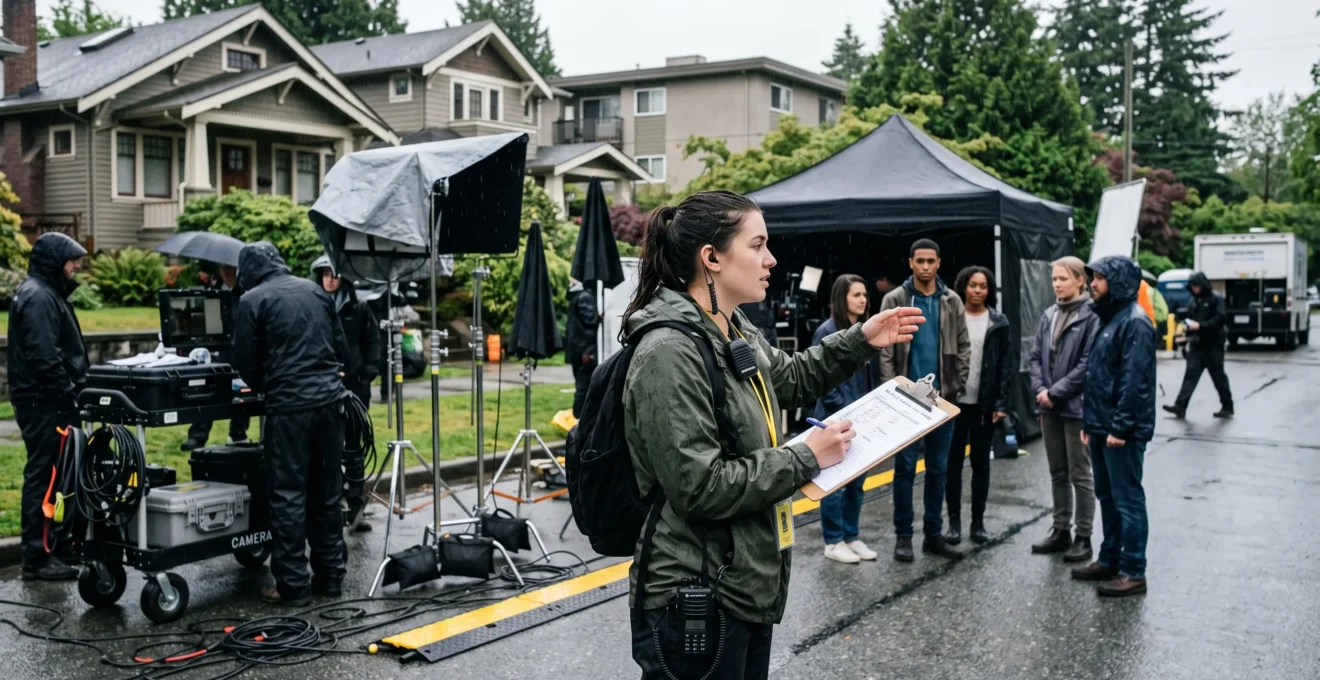
Your first job in Vancouver’s film industry does not have to come through a relative, a film school connection, or a producer willing to take a personal chance on you. British Columbia has established entry routes through production assistance, background casting, non-union shoots, and companies supplying services to working sets. The challenge is understanding which opportunities are genuinely accessible and what each can lead to.
A background booking might provide your first paid day on a production without giving you a screen credit. A Production Assistant position may be more relevant if your goal is to build a long-term crew career. Post-production and production-office jobs follow different recruitment paths again.
For newcomers in Vancouver, the practical strategy is to identify the right department, complete training that genuinely applies to that pathway, register with legitimate hiring channels, and become available when productions need workers. Connections develop from repeated professional contact; they do not have to be inherited.
Getting into Vancouver’s film industry: the essentials
- Start with accessible work: background performance, non-union productions, production services, or entry-level PA opportunities.
- Choose your longer-term direction early. Set work, post-production, and office coordination demand different skills and schedules.
- Verify training requirements before paying, monitor production activity, and use each professional interaction to build a reliable reputation.
- Why Does Vancouver Stay « Hollywood North » Even When Other Cities Slow Down?
- How to Land a Starter Role in Vancouver Film in 30 Days Without Knowing Anyone?
- Set, Post, or Production Office: Which Vancouver Film Path Fits You If You Hate 14-Hour Days?
- The Gig Trap That Costs Vancouver Film Newcomers $1,500 in « Training » Fees
- When Is the Best Time to Apply for Vancouver Film Crews to Avoid a 6-Week Dry Spell?
- Why Do Vancouver Film Studios Hire Fast, Then Pause Hiring for 4 Weeks?
- Why Does Gastown Create More Warm Intros Than Online Applications in Vancouver?
- What Do Vancouver Film Production Studios Look for Before They Call You Back?
Why Does Vancouver Stay « Hollywood North » Even When Other Cities Slow Down?
Vancouver remains an established screen-production centre because it combines production infrastructure, experienced crews, provincial tax incentives, and access to the American entertainment market. These advantages help the city compete for projects, but they do not make it immune to industry downturns. A strong production ecosystem can exist alongside periods when newcomers struggle to find work.
The city and surrounding Metro Vancouver municipalities offer established sound stages, equipment suppliers, specialized production companies, and crews experienced in large film and television projects. Facilities associated with Canadian Motion Picture Park, Vancouver Film Studios, and Bridge Studios form part of this infrastructure.
Vancouver’s location also supports cross-border production relationships. Los Angeles-based companies can work with British Columbia crews while coordinating with personnel in California. Exchange-rate differences between the Canadian and US dollars can affect production budgets, although their practical importance varies with contracts, costs, and currency movements.
Provincial tax credits are another structural factor. British Columbia operates two distinct programs serving different kinds of production:
- Production Services Tax Credit (PSTC): supports qualifying Canadian and international productions without requiring Canadian-content certification.
- Film Incentive BC (FIBC): supports qualifying Canadian-owned and controlled productions meeting applicable Canadian-content requirements.
The distinction matters to jobseekers because large international service productions often recruit through established departmental networks, while some smaller domestic projects, commercials, and independent productions may offer more approachable entry points.
Creative BC’s Motion Picture Tax Credit Reports document the province’s certification activity and distinguish these programs. However, certification dates do not necessarily match filming dates, and approved budgets are not a real-time count of available crew jobs.
Production activity also fluctuates with commissioning decisions, project schedules, and broader industry conditions. Historically recognizable seasonal patterns should therefore be treated as context, not reliable promises that winter or spring will bring particular numbers of vacancies.
For someone entering the industry, the useful question is not whether Vancouver is always busy. It is whether new productions are preparing to hire in the departments that accept beginners.
That distinction leads to a practical next step: identifying entry routes that do not depend on joining an established crew before gaining any experience.
How to Land a Starter Role in Vancouver Film in 30 Days Without Knowing Anyone?
To pursue a first Vancouver film job within 30 days, apply through several legitimate entry channels rather than waiting for a studio to advertise an opening. Background casting, production-service employers, non-union shoots, and Production Assistant opportunities offer different ways to start. Thirty days is a useful action plan, not a guaranteed hiring deadline or professional screen-credit timeline.
Production Assistant work is an established entry route into British Columbia’s below-the-line workforce. Location-department PAs may assist with site preparation, communications, coordination, and other assigned duties under supervision. Although previous film experience is not inherently required for entry-level PA work, applicants still need to meet the expectations of the production and relevant hiring arrangements.
Other possible starting points include:
- Background performance: register with legitimate local casting agencies and provide accurate availability, photographs, and contact details. Background work offers exposure to set procedures but is not equivalent to a crew credit.
- Set support and traffic control: investigate specialist employers supplying these services, including whether particular positions require training, certifications, or licensing.
- Catering and craft services: approach established food-service providers that support productions, using any existing hospitality experience.
- Independent productions: look for appropriately organized commercials, documentaries, short films, or smaller non-union projects seeking assistants.
Companies providing production-related services, potentially including organizations such as MBS or Code 1 where the relevant local service is confirmed, should be approached through their genuine recruitment channels. A recognizable company name alone is not evidence of an available opening.
For aspiring crew members, the Directors Guild of Canada, British Columbia (DGC BC), is especially relevant. Its covered work includes Production Assistants on many union-signatory productions, and the pathway described by Creative Pathways includes a Permittee Logbook Holder Program and the accumulation of 30 PA Helper workdays. Those are documented workdays, not an instruction to secure 30 days of employment within a month.
Creative Pathways’ below-the-line career pathway explains PA entry, preparation, and professional progression. It identifies Motion Picture Industry Orientation and Motion Picture General Safety Awareness within its described pathway, with other training dependent on duties. Applicants should verify current DGC BC requirements before enrolling or applying.
Your first 30 days: five actions with measurable results
- Days 1–5: Choose two realistic entry routes and produce a one-page resume highlighting punctuality, communication, physical readiness, and relevant experience.
- Days 6–10: Register with legitimate background agencies or suitable recruitment pools. Keep a dated record of completed profiles and responses.
- Days 11–15: Check the safety preparation required for your preferred jobs. Create a list distinguishing mandatory training from optional certifications.
- Days 16–23: Contact suitable production-service employers and non-union production opportunities. Maintain a tracker of applications, departments, and available dates.
- Days 24–30: Review responses, update availability, and make appropriate follow-ups. Finish with a verified contact list and a clear plan for the following production cycle.
A first paid day may involve background holding, physical support, or administrative tasks rather than a recognizable film credit. Ask how your work will be classified and whether it can be listed professionally before claiming a credited production role.
Once the first opportunities become visible, the more important decision is whether the working conditions and skills involved suit the career you want to develop.
Set, Post, or Production Office: Which Vancouver Film Path Fits You If You Hate 14-Hour Days?
If long, unpredictable filming days are incompatible with your life, investigate post-production or production-office positions instead of assuming every Vancouver film career begins on set. On-set employment frequently demands substantial schedule flexibility; post and office jobs can provide more structured working patterns, although deadlines, overtime, and contract instability still apply. Each route develops different professional skills.
On-set departments work around filming schedules, location access, weather, and production requirements. Early starts, late finishes, physical work, and changes to the day’s plan can all affect availability. A PA may need to travel across Metro Vancouver before ordinary office hours.
Post-production is a separate professional environment. Editing, sound, visual effects, animation, and post-production coordination require skills that do not automatically follow from general set experience. Vancouver’s VFX ecosystem includes companies such as Sony Pictures Imageworks and Industrial Light & Magic Vancouver, but their hiring requirements depend on particular positions and projects.
Production-office roles involve scheduling, document handling, communications, accounting support, travel logistics, and administrative coordination. Office PAs and assistants may have more conventional working locations, though production deadlines can still create irregular hours.
The practical differences can be summarized as follows:
| Decision factor | On-set crew | Post-production | Production office |
|---|---|---|---|
| Typical schedule | Variable filming days | More structured, with deadline peaks | Often office-based, with overtime possible |
| Physical demands | Often substantial | Usually desk-based | Generally lower, depending on role |
| Useful starting skills | Safety, stamina, communication | Software, technical or coordination skills | Administration, organization, spreadsheets |
| Possible first targets | PA helper, non-union set assistant | Junior support, VFX production assistant | Office PA, administrative assistant |
| Career progression | Department-specific production experience | Creative, technical or pipeline specialization | Production coordination and management |
Ask yourself which inconvenience you can consistently tolerate. If physical demands and changing locations appeal to you, set work deserves investigation. If you enjoy software-based problem-solving, post may be a stronger direction. If schedules, documents, suppliers, and people management are your strengths, consider the production office.
Early specialization has consequences. Several years of set PA experience may build valuable contacts and production knowledge, but it does not automatically qualify someone for a technical VFX position. Similarly, office administration and creative editing have different progression requirements.
You can apply to more than one pathway initially, provided each application is tailored. Over time, concentrate on the route that best matches your desired work and living conditions.
The next investment should be in demonstrably useful qualifications, not expensive courses marketed as a universal shortcut into all three careers.
The Gig Trap That Costs Vancouver Film Newcomers $1,500 in « Training » Fees
A $1,500 film-training offer is not automatically fraudulent, but paying that amount for promised industry access can be a costly mistake if no employer or guild requires the credential. Vancouver newcomers should separate legitimate education from recruitment promises, verify the institution where applicable, and check whether a particular course improves eligibility for the jobs they actually intend to pursue.
Film production involves specialized training, but not every impressive-sounding certificate represents a recognized hiring requirement. A provider might advertise introductions to producers, priority placement, or an accelerated route onto union crews. Such marketing claims require independent verification.
Warning signs include:
- A guarantee of paid film employment without a clearly explained employer relationship or recruitment process.
- Pressure to pay immediately to preserve a supposed production opening.
- Claims that a private certificate is compulsory without identifying the relevant guild, agreement, or employer requirement.
- Unclear refund conditions, course content, assessment methods, or instructor qualifications.
- Requests to pay an individual rather than a verifiable training business.
British Columbia provides a concrete verification resource. The British Columbia’s Private Training Institution Directory lets prospective students check certified institutions, programs, and relevant regulatory information. The Private Training Act governs institutions within its scope, but not every short workshop necessarily requires certification.
Institutional certification is not the same as accreditation, and neither is a promise of employment. An unlisted informal workshop is not automatically a scam. The meaningful checks are whether regulation applies, whether the provider’s claims can be substantiated, and whether employers value the actual qualification.
For safety training, terminology also matters. British Columbia replaced the former Occupational First Aid Level 1 designation with Basic first aid under changes effective November 1, 2024. WorkSafeBC describes Basic first aid as seven hours of training. A newcomer should not assume that every PA or background role requires first-aid certification.
Similarly, WHMIS, motion-picture safety courses, and traffic-control training serve different purposes. A certificate is useful when it satisfies a genuine role requirement or prepares the worker for identifiable duties, not merely because a training seller promotes it.
Consider a hypothetical beginner offered a $1,500 package promising quick crew access. Before paying, that applicant could ask the provider to identify the recognizing employer or guild, check the institution’s regulatory status where applicable, and compare the course against requirements for actual available roles. If those checks fail, the applicant can redirect the budget toward necessary preparation and living expenses.
The opportunity cost may exceed the training fee. Weeks spent pursuing an irrelevant certificate are weeks not spent applying to labour pools, learning local hiring practices, or gaining legitimate production experience. Someone who has already paid should assess the provider’s documented refund terms rather than paying for additional promised credentials.
Even with legitimate training and an appropriate resume, securing work still depends on demand, which is why understanding production cycles matters as much as qualifications.
When Is the Best Time to Apply for Vancouver Film Crews to Avoid a 6-Week Dry Spell?
The best time to apply for Vancouver film work is when new projects are entering preparation, not necessarily during a particular month of the year. Hiring follows production decisions, departmental planning, and filming schedules. Monitoring early preparation activity gives applicants a better signal than relying on a fixed seasonal calendar, although no method can eliminate a six-week gap between opportunities.
Different productions begin recruiting at different times. A returning series, a new streaming project, and a short commercial campaign can each generate separate hiring waves. Public announcements about commissioning or filming may offer clues, but they are not promises that entry-level positions are available.
One useful approach is to distinguish leading signals from late signals. Production-office staffing, location planning, accounting recruitment, and other preparation work may begin before the busiest filming phase. Waiting until photographs of active shoots circulate can mean arriving after much of the initial crew selection.
Newcomers can build a repeatable monitoring routine:
- Review public production information from Creative BC and other legitimate provincial industry resources.
- Check DGC BC production information and any applicable permitted recruitment channels.
- Follow credible local job boards and moderated film-industry communities for verified calls.
- Track productions entering preparation rather than recording only filming announcements.
- Apply according to departmental requirements and update availability when circumstances change.
The distinction between preparation and filming also helps explain why an office opportunity might be visible while an on-set department has not begun taking applicants. It does not establish a universal number of weeks between recruitment stages.
During periods when major series are quiet, investigate commercial, documentary, music-video, corporate-video, and independent production opportunities. These sectors have their own fluctuations, but appropriately organized non-union work may provide additional chances to gain relevant experience.
Financial planning is equally important. Film workers can face irregular earnings even after becoming established. A useful gap fund should reflect actual housing, transport, food, insurance, and other essential expenses rather than an arbitrary industry-wide savings figure.
Canadian Employment Insurance eligibility depends on individual circumstances and the applicable program requirements. Do not assume that every gap between contracts qualifies for benefits; verify the current rules directly with Service Canada before relying on that income.
Recruitment waves also explain a frustrating industry experience: seeing several positions filled rapidly, followed by a long period with no response from the same production.
Why Do Vancouver Film Studios Hire Fast, Then Pause Hiring for 4 Weeks?
Vancouver productions can hire rapidly because many positions must be filled before filming begins. Once a department is staffed, recruitment may slow until someone leaves, a new requirement appears, or another project starts. A four-week silence does not necessarily indicate rejection, but neither does it mean an applicant remains under active consideration. Hiring pauses have no universal duration.
Unlike organizations that recruit continuously for permanent positions, film productions assemble teams around specific projects. Work is allocated according to the production’s schedule, budget, departmental structure, and available personnel.
A production may need office and accounting personnel during preparation, department leadership before major operations, and additional crew as filming approaches. These are tendencies rather than an identical hiring order on every project.
The relevant employer may also differ from the company whose name appears on a studio building. Physical studio facilities host productions, while individual production entities and their departments make many of the actual staffing decisions. Sending an unsolicited resume to a studio operator is therefore not always the same as applying to the production working inside it.
For a newcomer, a quiet period is useful for three specific tasks:
- Update your availability: ensure relevant contacts know when you can accept work and whether your certifications or contact information have changed.
- Prepare for the next project: identify departments and employers likely to need your skills rather than repeatedly approaching an already staffed show.
- Maintain professional relationships: follow up when there is a legitimate reason, such as a new production cycle, an announced return, or a relevant change in availability.
A production coordinator or department administrator may be an appropriate contact where public or professional channels permit communication. Avoid guessing private email addresses, contacting people indiscriminately, or treating a crew list as an invitation to solicit everyone on it.
One concise follow-up per meaningful production cycle is a sensible starting practice, not an official industry rule. A message can remind a previous contact of your department interest, recent relevant work, and upcoming availability without requesting preferential treatment.
If the production has already filled its positions, the useful response is to keep exploring other projects. No reply should be interpreted as neutral until a hiring decision is confirmed.
Technical preparation and timely applications increase the chance of being considered, but professional familiarity can also help an applicant become recognizable when suitable work appears.
Why Does Gastown Create More Warm Intros Than Online Applications in Vancouver?
Gastown can offer opportunities to meet people involved in Vancouver’s creative industries, but there is no reliable evidence that the neighbourhood produces more film-job introductions than online applications. Its downtown events, creative businesses, and professional gatherings may support useful conversations. For film newcomers, the effective strategy is to combine legitimate in-person networking with formal applications and departmental recruitment channels.
Vancouver’s production ecosystem is spread across several areas rather than concentrated entirely in Gastown. Major studios, technical facilities, and filming locations operate throughout Metro Vancouver, while downtown spaces can host creative businesses, events, and professional meetings.
The value of meeting someone in person is not that a casual conversation overrides recruitment requirements. It is that a person may remember your professional interest, understand your skills, and eventually point you toward an appropriate public opportunity or introduce you to a relevant contact.
Potential networking touchpoints include industry events organized by local film organizations, public education and industry gatherings associated with Vancouver Film School, events involving Women in Film & Television Vancouver, and gatherings open to eligible participants through professional bodies such as DGC BC.
Before attending, check whether an event is open to newcomers or restricted to members. A private production gathering or working equipment counter should never be treated as an unsolicited recruitment venue.
A conversation is more productive when it concerns someone’s work rather than an immediate request for a job. At an appropriate public event, a newcomer interested in locations could ask what skills help entry-level PAs perform well or how hiring differs between non-union work and guild-covered productions.
A professional exchange might follow this sequence:
- Introduce your interest in a specific department and mention any genuinely relevant experience.
- Ask one informed question about the work or entry route.
- Listen without turning the exchange into a sales pitch for your resume.
- If the other person welcomes continued contact, request an appropriate professional channel.
- Send a brief follow-up referring to the conversation and any useful information exchanged.
For example, a follow-up could thank an event participant for explaining locations work and mention that you have reviewed the recommended training requirements. An invitation to apply should come through the relevant hiring process, not through an assumption that the person owes you an introduction.
Online applications remain essential. Guild processes, casting registries, vendor recruitment pages, and legitimate vacancies help employers manage eligibility and availability. Professional networking supports these channels; it does not replace them.
Whether an employer discovers your name through a recruitment list or a professional introduction, the eventual callback depends on evidence that you can perform the work reliably.
What to have ready before a Vancouver film employer contacts you
- One concise, role-specific resume that shows relevant experience and accurate availability.
- Verified training or certificates where required, without claiming optional courses are compulsory.
- Professional references and a realistic plan for reaching the work location on time.
What Do Vancouver Film Production Studios Look for Before They Call You Back?
Vancouver film employers considering entry-level applicants generally need evidence of reliability, availability, role-relevant preparation, and clear communication. A newcomer without production credits can still demonstrate these qualities through transferable employment experience and suitable references. Screening criteria vary by department and employer, and no single certificate, contact, or resume format guarantees a callback.
From a coordinator’s perspective, a hiring decision often involves immediate operational questions. Can this person arrive at the required location? Can they follow instructions safely? Will they communicate quickly if something changes? Do they understand the department they are applying to?
A practical entry-level resume should make the answers easy to find. Include an accurate phone number, a professional email address, your general Metro Vancouver work location or mobility, relevant training, and a short record of previous experience.
Describe transferable skills specifically instead of presenting unrelated employment as film experience:
- Customer service: demonstrates courteous communication, handling instructions, and remaining composed during busy periods.
- Warehouse or delivery work: may demonstrate physical organization, safety awareness, and experience with time-sensitive tasks.
- Event operations: can demonstrate crowd coordination, schedule changes, and working around multiple teams.
- Office administration: supports applications involving spreadsheets, document control, schedules, and communication.
None of these examples should be described as prior set employment unless that is factually correct. Employers need to know what you have done, not what a resume has been made to imply.
References should come from people who can confirm actual professional behaviour. A former manager who can describe your attendance and communication may provide a more credible reference than a film-industry acquaintance who has never worked with you.
Similarly, employment gaps are not automatically disqualifying. Present accurate dates and explain relevant activities when appropriate. Do not invent credits, responsibilities, or qualifications to make a resume appear more industry-specific.
A short application is generally easier to assess when it identifies the precise role, relevant preparation, and availability. For example:
Subject: Entry-level Locations PA availability — Vancouver
Hello, I’m interested in entry-level Locations PA opportunities in Metro Vancouver. My previous work involved event logistics and customer coordination. I’m available for early starts and can provide references. I can also confirm my completed safety training and any additional eligibility requirements relevant to your production. Thank you for considering my application.
Adjust the message to your actual situation, and send it only through a legitimate contact or application channel. If a specific certification has been completed, name it accurately. If you are uncertain whether it is required, ask instead of suggesting you already qualify.
Professional reputation begins with the first assignment. Arrive according to the employer’s instructions, respect confidentiality, follow safety procedures, and communicate promptly about problems. A reliable day of work can produce a meaningful reference even if it never becomes a visible film credit.
For newcomers interested in formal crew careers, the difference between paid employment, documented workdays, union-related eligibility, and a screen credit is particularly important. Confirm which category an opportunity belongs to rather than assuming every production booking advances each goal equally.
Your next practical step is to select one entry-level role, prepare a truthful resume for it, verify its actual prerequisites, and contact suitable employers through their established channels. The objective is not to appear connected; it is to become someone a production can confidently hire when appropriate work is available.
Can you work on a Vancouver film set without joining a union?
Some non-union productions and production-service employers offer opportunities outside guild-covered positions. Commercials, independent films, and other smaller projects may provide possible entry routes. However, eligibility depends on the specific employer and work being offered. Union-signatory productions have their own applicable requirements, so a non-union booking does not automatically establish eligibility for a guild-covered crew position.
Does background acting count as a professional film crew credit?
Background performance is legitimate production work, but it is different from holding a crew position in locations, camera, production management, or another department. A paid background booking does not necessarily result in an on-screen credit or count toward a department’s documented workday requirements. Represent the experience accurately and check the relevant professional eligibility rules.
Do you need to live in Vancouver itself to get production work?
Not necessarily. Productions operate across Metro Vancouver and surrounding areas. What matters for many entry-level positions is whether you can reliably reach assigned locations at required times. Some calls may begin before convenient public transit services or involve changing locations. Confirm transportation expectations for each opportunity rather than assuming every set is downtown.
Can international newcomers work in Vancouver film production?
International newcomers may pursue eligible opportunities if they have the legal authorization required for the employment in question and meet any applicable hiring or professional requirements. Film training, casting registration, or an introduction to a producer does not itself grant permission to work in Canada. Verify your individual authorization through the appropriate Canadian government channels before accepting paid work.
What should you do if your first applications receive no responses?
Check whether the roles genuinely accept beginners, whether your qualifications are relevant, and whether applications went through the correct channels. Update your availability, broaden your search to appropriate non-union and production-service work, and follow up only when useful. A lack of replies during a quiet production period is not proof that an applicant is unsuitable, but it is a reason to review the strategy and continue exploring legitimate opportunities.