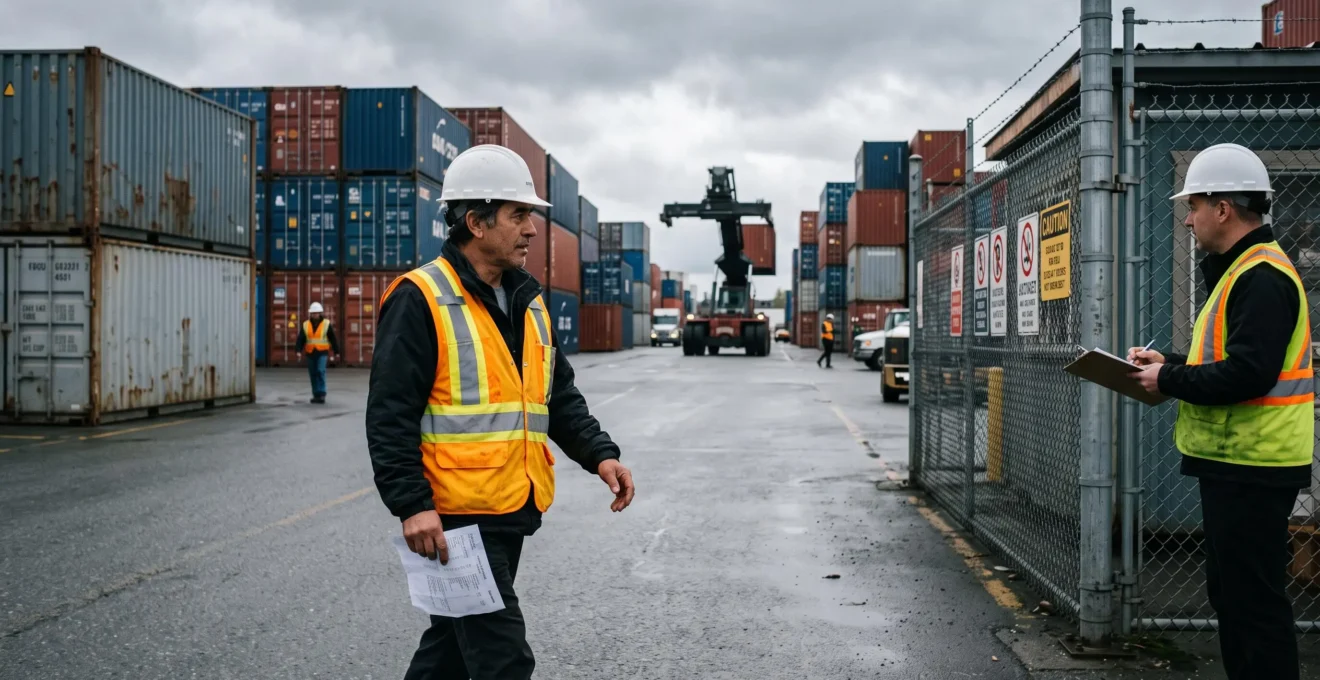
A Metro Vancouver freight logistics employer expects a new hire to arrive on time, follow site safety procedures, understand assigned duties, present required documentation and communicate clearly when something is wrong. Nobody should expect a first-day worker to know every terminal or warehouse process. What matters is whether that worker can become a dependable member of the operation without creating unnecessary risk.
That expectation takes different forms across container terminals, distribution centres, freight forwarding offices and third-party logistics warehouses. A terminal shift may depend on vessel activity and coordinated equipment movements. An inland warehouse may work around truck appointments, receiving schedules, picking deadlines and dispatch cutoffs.
For candidates entering logistics employment in Delta, Surrey, Richmond, Vancouver or neighbouring municipalities, preparation starts before the interview. Availability, transportation, safety awareness and the documents required for the specific position all affect whether a promising job is sustainable.
The goal is straightforward: secure a role whose operational expectations you can meet consistently, starting with your first assigned shift.
Metro Vancouver logistics employment: the essentials
- Reliability means arriving ready for your assigned shift, maintaining realistic availability and communicating problems promptly.
- Safety awareness means recognizing hazards, following instructions and understanding when work must stop.
- Before accepting an offer, confirm your required credentials, work location, shift schedule and actual commute at the hours you will travel.
- Why Do Metro Vancouver Logistics Jobs Emphasize Reliability More Than Resume Keywords?
- How to Show Shift Flexibility on Your Vancouver Logistics Resume Without Looking Desperate?
- Port Terminal or Inland Warehouse: Which Metro Vancouver Logistics Path Pays Off Faster?
- The Safety Mistake That Gets Metro Vancouver Logistics Candidates Rejected After a Great Interview
- When Should You Apply for Metro Vancouver Logistics Roles to Catch Peak Hiring Without Burnout?
- Why Do Vancouver Trade Employers Care More About Documentation Than « Sales Skills »?
- How to Plan Your Metro Vancouver Job Search Around Transit Time in 3 Simple Steps?
- Which Metro Vancouver City Gives You the Best Job Odds With a Commute Under 45 Minutes?
Why Do Metro Vancouver Logistics Jobs Emphasize Reliability More Than Resume Keywords?
Reliability matters in Metro Vancouver freight logistics because operational work depends on coordinated people, equipment and delivery windows. A worker who consistently arrives ready for assigned shifts helps the team maintain its schedule. Resume keywords may help identify relevant experience, but they cannot demonstrate whether someone will reliably perform the work.
Consider a hypothetical distribution centre preparing outbound freight for scheduled truck departures. A missing worker may require supervisors to redistribute loading, scanning or staging duties. If staffing is already tight, this can slow an entire work sequence rather than merely leave one individual task unfinished.
Container terminals face their own coordination challenges. Vessel operations, equipment availability and workforce assignments must align. The consequences of one absence depend on available replacement staff, the particular operation and the employer’s scheduling arrangements; not every absence produces a cargo delay.
That is why candidates should make past reliability visible through concrete experience rather than relying entirely on descriptions such as « motivated » or « hardworking. »
- Attendance: describe a position in which you consistently covered assigned shifts, without inventing attendance percentages.
- Schedule responsibility: identify genuine experience with early starts, evening work, weekend coverage or rotating shifts.
- Supervisor verification: prepare references who can accurately discuss your punctuality, work habits and responsibilities.
- Operational continuity: explain how you completed handovers or communicated scheduling conflicts before they disrupted colleagues.
For example, a candidate who previously worked in food service could write: « Covered scheduled opening shifts and coordinated shift handovers with the closing team. » That description is useful only if it accurately reflects the candidate’s experience.
Reliability also protects the employee. Claiming unrestricted availability can create expectations that become impossible to meet once transportation or personal commitments interfere.
For employees covered by British Columbia’s provincial employment standards, statutory termination notice or compensation generally begins after 3 months of employment. The British Columbia government’s guidance on quitting or getting fired explains the applicable thresholds. Federally regulated transportation work, collective agreements and employment contracts can involve different provisions; the absence of a provincial statutory notice entitlement does not permit unlawful dismissal.
The practical lesson is not that every missed shift causes termination. It is that a candidate should make commitments that remain realistic beyond the first interview.
Once reliability is clearly demonstrated, the next question is how to describe availability without promising a schedule you cannot maintain.
How to Show Shift Flexibility on Your Vancouver Logistics Resume Without Looking Desperate?
Show shift flexibility by stating the schedules you can genuinely work, supported by relevant experience. Specific availability is more useful than promising to accept any shift at any time. A clear statement helps employers assess staffing compatibility while protecting you from commitments that become unsustainable after hiring.
Logistics schedules vary significantly. Some operations run recurring daytime or overnight shifts; others need weekend coverage, changing start times or casual call-in availability. Terminal scheduling may also be governed by collective agreements and employer-specific assignment procedures.
A candidate should therefore distinguish between being willing to work unusual hours and being genuinely equipped to reach the worksite at those hours.
Consider the following resume examples:
| Less useful wording | Stronger, verifiable wording |
|---|---|
| « Available anytime for anything. » | « Available for rotating shifts, including evenings and weekends. » |
| « Urgently need full-time hours. » | « Seeking full-time warehouse work; available for weekday early starts. » |
| « Flexible and hardworking. » | « Previously covered weekend receiving shifts and coordinated team handovers. » |
| « Can start whenever required. » | « Available to start after the required notice period; overnight availability confirmed. » |
Use these formulations only when accurate. If you are unavailable on certain weekdays, have a limited overnight transportation window or require advance notice for childcare, establish those boundaries before accepting an assignment.
At interview, separate your current availability from possible future changes. You might explain that you can work an established evening rotation but would need advance agreement before switching to unpredictable overnight calls.
Unionized port positions can have assignment rules based on seniority, dispatch arrangements or other collective agreement provisions. Do not assume that casual employees can select preferred shifts, that seniority operates identically everywhere or that additional shifts are guaranteed.
Before accepting an offer, confirm whether the role involves fixed hours, rotation, mandatory overtime, on-call assignments or minimum-notice requirements. These details matter more than a general promise of flexibility.
A realistic schedule gives you a better basis for comparing terminal and inland warehouse opportunities, where the route into steady work may look quite different.
Port Terminal or Inland Warehouse: Which Metro Vancouver Logistics Path Pays Off Faster?
Inland warehouse positions may offer a more direct route into regular entry-level work, while port terminal employment can provide distinct longer-term opportunities through established staffing and collective agreement structures. Neither path guarantees faster advancement or higher lifetime earnings. The better choice depends on access to openings, qualifications, scheduling stability, compensation and commuting costs.
Metro Vancouver offers several operational environments. Port-related work can involve container handling, yard movements and vessel-linked schedules. Inland warehouses and third-party logistics facilities commonly focus on receiving, storage, picking, cross-docking and outbound transportation coordination.
For a new candidate, the central distinction is the actual employment arrangement, not simply whether a job advert contains the word « port. »
| Decision factor | Port terminal | Inland warehouse or 3PL |
|---|---|---|
| Entry route | May involve specialized qualifications, employer recruitment or union-related hiring arrangements | May offer a more direct application route for general entry-level duties |
| Initial work consistency | Depends on whether the position is casual, permanent or otherwise scheduled | Depends on the contract, operating hours and staffing needs |
| Wage progression | May follow established classifications and collective agreement provisions | May depend on skills, responsibility, employer policies and job changes |
| Union representation | Present in important parts of terminal operations, but must be verified by position | Varies among workplaces |
| Physical demands | Can involve outdoor conditions, moving equipment and active yard environments | Can involve lifting, standing, repetitive handling and powered equipment |
| Schedule predictability | Varies significantly between casual and established assignments | Varies between fixed shifts, rotating schedules and seasonal staffing |
For port employment, identify the specific employer, recruitment channel and employment classification. Some arrangements involve casual assignments before access to more regular work. However, there is no universal casual-to-permanent progression timeline, and collective agreements must be checked individually.
Inland warehouses around Delta, Surrey and Richmond can be worth investigating when the immediate objective is to find a reachable entry-level position. This is a search strategy rather than a verified ranking of local hiring speed.
Compare total employment value rather than hourly pay alone. A hypothetical job paying more per hour could still be less attractive if it offers unpredictable shifts, substantial transportation expense or a commute that regularly threatens punctuality.
Before deciding, ask each employer about guaranteed hours, overtime expectations, required training, benefits eligibility and progression criteria. Compare written offers rather than relying on assumptions about entire industries.
Whichever workplace you choose, safety awareness remains essential because freight operations place employees near vehicles, equipment, moving loads and other potential hazards.
The Safety Mistake That Gets Metro Vancouver Logistics Candidates Rejected After a Great Interview
A serious safety interview mistake is giving a generic answer that shows no ability to recognize or respond to a hazard. Saying « I always follow the rules » does not explain what you would do around a moving forklift, unsecured load or blocked pedestrian route. A stronger answer identifies the risk, describes a safe response and respects site procedures.
Safety questions deserve preparation because logistics work regularly combines people, vehicles, lifting equipment and freight handling. Employers may use scenario questions to evaluate practical judgment, although there is no verified basis for claiming that one generic answer automatically leads to rejection across Metro Vancouver.
Prepare examples around situations such as:
- Forklift-pedestrian separation: staying within designated pedestrian areas and avoiding equipment operating zones.
- Load stability: identifying apparently unsecured or unstable freight and notifying the appropriate person.
- Personal protective equipment: understanding that required equipment depends on the worksite and task.
- Traffic controls: respecting marked walkways, barriers, signs and instructions from designated personnel.
Suppose an interviewer asks what you would do if a forklift is operating close to a pedestrian walkway. A useful response is: « I would stay clear of the equipment’s operating area, follow the site’s pedestrian traffic controls and report any unsafe condition to the supervisor rather than trying to pass through. »
The goal is to show hazard recognition without pretending to possess equipment qualifications or site-specific knowledge you have not acquired.
British Columbia also establishes a formal procedure for refusing unsafe work. Under the applicable WorkSafeBC framework, workers must not perform work when they have reasonable cause to believe it would create an undue safety hazard. They must promptly notify their supervisor or employer, after which the prescribed investigation procedure applies.
If the concern cannot be resolved through the workplace investigation stages, WorkSafeBC must be contacted. The WorkSafeBC guidance on refusing unsafe work explains this process and the associated protections against prohibited discipline or penalties. Workers in federally regulated workplaces should also verify the applicable federal occupational health and safety requirements.
Ordinary hazard reporting and formal unsafe-work refusal are related but distinct processes. Learning when each applies is more valuable than memorizing a generic safety slogan.
Before an interview, candidates can also review publicly available employer information, including applicable WorkSafeBC registration or clearance information where relevant, without interpreting a clearance record as proof of a hazard-free workplace.
Ask a practical question: « What safety orientation and supervised training will new employees complete before entering active operating areas? »
Safety judgment is a continuing responsibility, not a one-time interview performance. Candidates should plan their job search and eventual work schedules with enough time and energy to carry out those responsibilities consistently.
When Should You Apply for Metro Vancouver Logistics Roles to Catch Peak Hiring Without Burnout?
Apply before anticipated busy periods, but maintain a steady search throughout the year. Warehouse recruitment may respond to retail demand, shipping activity and employer-specific staffing cycles, while terminal openings follow different operational and recruitment arrangements. Seasonal patterns are useful planning signals, not guarantees that a particular employer will recruit during a fixed month.
For warehouse roles connected to retail distribution, it can be reasonable to monitor hiring ahead of holiday-related demand. As a practical planning tactic, begin preparing applications roughly four to eight weeks before a suspected hiring ramp-up. This is a candidate scheduling strategy, not a verified Metro Vancouver-wide recruitment lead time.
Some employers may also recruit around the beginning of the calendar year, but the timing and scale vary. Confirm current opportunities through actual postings rather than assuming that seasonal demand automatically creates entry-level vacancies.
A manageable application pipeline should include three activities: monitoring roles, submitting targeted applications and maintaining the documentation needed to respond promptly when employers make contact.
- Identify employers and role types that match your qualifications and travel options.
- Check active postings at a sustainable frequency rather than sending large batches of poorly matched applications.
- Prepare your references and employment documentation before interview invitations arrive.
- Use slower application periods to address genuinely relevant training gaps.
- Review each application outcome and adjust your search based on actual employer requirements.
Do not assume that taking every available overtime shift will improve your standing. For someone learning equipment procedures, warehouse traffic patterns or shift work, inadequate rest can undermine concentration and consistency.
Sustainable availability is especially important for candidates unfamiliar with overnight schedules. Consider transportation, recovery time, other commitments and the actual hours offered before agreeing to extended or rotating shifts.
Employers may value willingness to cover additional work, but this should never be treated as permission to bypass safety procedures, rest requirements or applicable employment rules.
When an opportunity appears, being prepared with accurate documentation can make the difference between responding immediately and discovering that a required credential needs attention.
Why Do Vancouver Trade Employers Care More About Documentation Than « Sales Skills »?
Documentation matters in freight and trade roles because shipments, regulated goods and equipment operations depend on accurate records and appropriate authorizations. A documentation error can interrupt handling or create compliance concerns. Communication and commercial skills remain useful, but they cannot replace a mandatory qualification or a correctly completed shipping document.
The exact records depend on the position. Freight forwarding staff may handle shipment instructions and transport documents, while warehouse employees may work with receiving records, inventory systems and dispatch information. Dangerous goods duties introduce additional regulatory requirements.
Common document categories include bills of lading, manifests, customs-related paperwork and dangerous goods shipping documents where applicable. A new warehouse worker is not necessarily responsible for preparing every type of document.
For regulated dangerous goods activities, Transport Canada describes requirements for adequate training and appropriate certification, or direct supervision by someone who is adequately trained and certified. The Transport Canada guidance on basic competency for transporting dangerous goods identifies relevant competencies and documentation requirements.
3 years / 2 years
Transportation of Dangerous Goods training certificates are generally valid for three years for road, rail and marine transport, and two years for air transport. These are transport-mode-specific validity periods, not universal certification requirements for all logistics employees.
Transport Canada — Basic competency for transporting dangerous goods.
Before starting, confirm exactly what the employer needs. A government-issued ID, evidence of work eligibility, appropriate equipment training or a driver’s licence may be relevant, but not every role requires every document.
Your five-action first-shift readiness checklist
- Confirm the assignment: save the worksite address, reporting location, supervisor contact and start time in one accessible note.
- Verify your availability: write down the agreed shift pattern and identify any unresolved scheduling questions.
- Prepare required documents: assemble an employer-specific checklist covering identification, work authorization and requested credentials.
- Check safety onboarding: obtain confirmation of required PPE, orientation arrangements and any duties requiring supervised training.
- Test your commute: record a viable outbound route, return route and contingency plan for the actual shift hours.
On a resume, a concise « Certifications and Compliance » section can make relevant qualifications easier to identify. Include only credentials you actually hold, with accurate status and expiry information when relevant.
Missing qualifications can prevent a candidate from meeting a position’s prerequisites, but it would be inaccurate to assume that all hiring systems automatically reject every applicant who lacks a particular certificate. Some employers provide necessary training after recruitment.
Even a candidate with every requested document still needs a practical way to reach the workplace, especially when the schedule falls outside ordinary commuting hours.
How to Plan Your Metro Vancouver Job Search Around Transit Time in 3 Simple Steps?
Plan your freight logistics job search around actual door-to-door travel at assigned shift times. Start by mapping precise workplace locations, then test transportation during early-morning and late-night windows. Finally, prioritize jobs with a reliable commute. A route that works during daytime may not be practical when industrial shifts begin or end outside regular transit service.
Metro Vancouver industrial employment is spread across several municipalities, and a job location described simply as « Delta » or « Richmond » may be far from the nearest convenient transit stop.
Use the following method before committing to an interview or employment offer.
- Map exact addresses: collect the employer’s physical reporting address and compare it with your home location, available transit stops and walking connections. Do not use city-centre distances as substitutes for the actual journey.
- Test the difficult shift: examine a possible 3 a.m. start or 11 p.m. start, along with the return journey, if those times are relevant to the job. Include transfer waiting, walking time and the possibility that some services are not operating.
- Rank feasible opportunities: prioritize roles you can reach consistently. Record whether the commute depends on a single bus, a carpool, personal driving or another arrangement, and identify a realistic backup.
Late-night transit can be particularly important for applicants considering rotating shifts. Metro Vancouver has NightBus and other transit services in selected areas, but service on a regional corridor does not establish that a specific industrial site is accessible throughout the night.
TransLink publishes regional schedules covering bus, SkyTrain and selected NightBus services. Its regional transit schedules provide the timetable information needed to investigate these trips. The reviewed directory identified schedules effective September 7, 2026; always check current schedules and service alerts before relying on a route.
A hypothetical applicant might find that a daytime journey takes under 45 minutes but that the return trip after a late shift requires a lengthy wait or has no convenient connection. That example illustrates why timing matters; it is not a verified journey to a specific warehouse.
Set your own commuting threshold based on the position. Forty-five minutes can be a useful screening target, but it is not a regional hiring standard or a guarantee of punctual arrival.
For a practical shortlist, record the job address, shift start and end, outbound journey, return journey and contingency option. This turns a vague preference for nearby work into an actionable employment decision.
With that information in hand, it becomes possible to compare Metro Vancouver employment zones without assuming that one municipality is automatically best for every candidate.
Key takeaways before choosing your job-search area
- Evaluate an employer’s exact industrial address, not simply the municipality listed in the vacancy.
- Compare both directions of travel at actual shift hours, including the last transit connection or a driving contingency.
- Prioritize a manageable group of reachable employers rather than expanding your search radius beyond what you can reliably sustain.
Which Metro Vancouver City Gives You the Best Job Odds With a Commute Under 45 Minutes?
No Metro Vancouver city offers universally better freight logistics job odds within a 45-minute commute. Delta, Surrey, Richmond and Vancouver each provide different logistics opportunities, but their accessibility depends on your starting point, transportation options, shift schedule and the precise workplace. The best location is the one with suitable openings you can reach reliably.
Consider the main employment areas by operational activity rather than treating municipal boundaries as a ranking of vacancy numbers.
| Area | Logistics opportunities to investigate | Commute consideration |
|---|---|---|
| Delta | Port-related activity, industrial warehouses, distribution and freight handling | Industrial sites may require additional travel beyond major transit corridors |
| Richmond | Warehousing, freight forwarding, cross-docking and distribution | Check the final connection between transit services and the actual facility |
| Surrey | Warehouses, trucking-related operations and distribution facilities | Confirm access to industrial districts rather than assuming SkyTrain reaches the workplace |
| Vancouver | Port-adjacent operations, freight coordination and selected industrial facilities | Compare terminal access and shift hours against the available transport network |
| Coquitlam area | Industrial, distribution and related logistics opportunities | Assess transfers, walking distances and service at nonstandard work hours |
These are geographic search categories, not measured vacancy totals or verified rankings. Without live posting counts and a candidate’s actual starting location, no defensible city-level probability of getting hired can be calculated.
For example, someone living near a convenient transit connection might find one Richmond workplace easier to reach than an apparently closer Delta industrial site. Another candidate with a car and access to major highways may reach a different set of employers comfortably.
Driving introduces its own considerations: traffic variability, bridge approaches, parking arrangements and fatigue after overnight shifts. Transit introduces service frequency, transfers and final-mile access. Neither mode is categorically more reliable across every job location.
Build your shortlist from reachable vacancies, not from assumptions about which city has the most warehouses. For every active posting, test the exact journey, verify the shift requirements and compare the role with your qualifications and employment priorities.
A candidate seeking a first warehouse position may reasonably prioritize regular hours and convenient transportation over a wider search for jobs that cannot be reached consistently. Someone seeking specialized terminal work may accept a different commuting arrangement if the actual employment terms justify it.
Choose three reachable logistics employers, verify their active openings and prepare applications that demonstrate your availability, safety awareness and applicable credentials. That is a more useful next step than selecting a city based on an unverified claim about hiring odds.
What should I bring to my first freight logistics shift?
Bring the identification, credentials and other onboarding documents specifically requested by your employer, along with required clothing or personal protective equipment if you have been instructed to provide it. Confirm the reporting location, start time, supervisor contact and orientation arrangements in advance. Ask rather than guessing when a requirement is unclear.
Can I start a Metro Vancouver warehouse job without forklift certification?
Some warehouse positions involve duties that do not require operating a forklift. Other positions require equipment-related training and authorization. Check the specific job description and employer training arrangements. Never operate powered equipment without the required instruction, competency and workplace authorization.
Do all Vancouver port logistics jobs follow British Columbia employment standards?
No. The applicable employment framework depends on the employer and the nature of its operations. Certain port, shipping and interprovincial transportation activities may be federally regulated. Collective agreements can also affect employment terms. Verify the applicable rules for the actual position rather than assuming that provincial standards govern every port-related job.
Should I pay for TDG or WHMIS training before applying?
First establish whether the position requires the training and whether the employer provides it. Transportation of Dangerous Goods requirements depend on the regulated tasks performed, and appropriately supervised work may be permitted in specified circumstances. TDG, WHMIS and equipment training serve different purposes and should not be treated as interchangeable qualifications.
What if I cannot reach the warehouse for an overnight shift?
Discuss the scheduling constraint before committing to the role. Check actual transit services, driving arrangements or possible carpool options, including the journey home. If the shift cannot be reached consistently, prioritize positions with compatible hours rather than promising attendance based on an uncertain transportation plan.