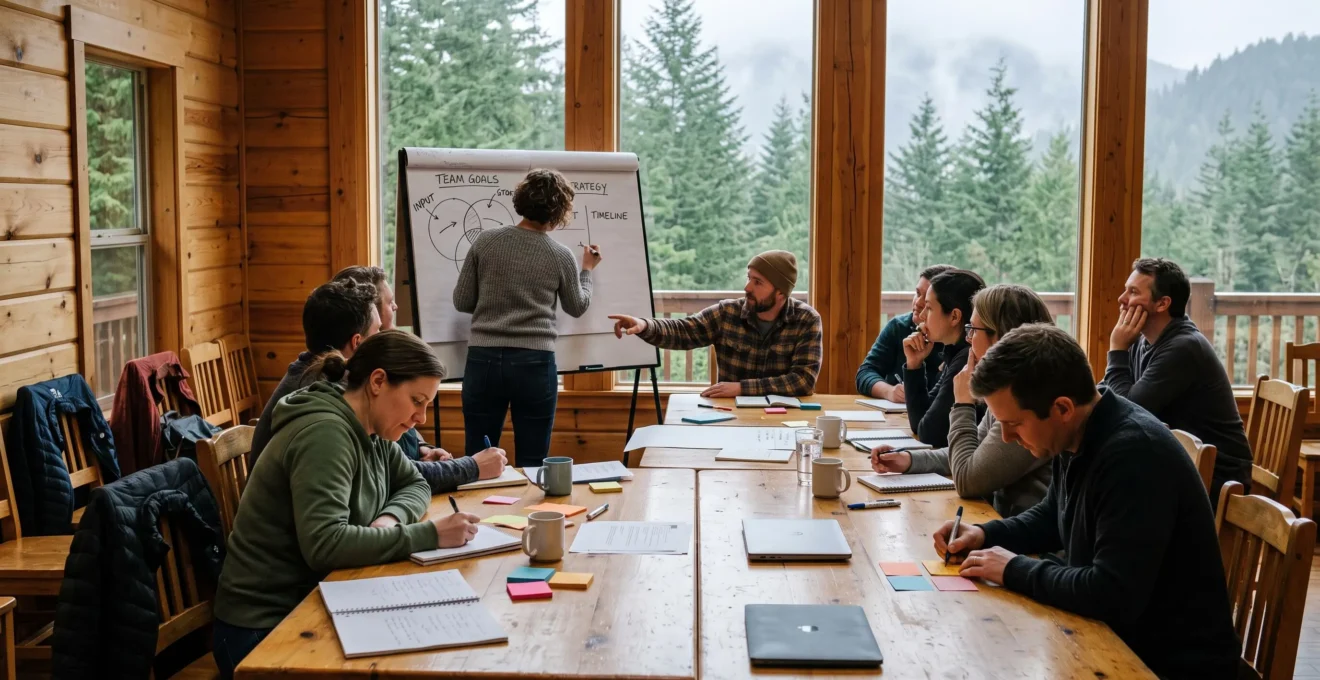
A Vancouver team-building retreat is worth its cost per person when it changes how colleagues work together after they return—not simply how much they enjoy the day. For managers responsible for culture budgets, the most valuable outcomes are observable: fewer unresolved handoffs, clearer communication expectations, better meetings and stronger accountability.
Vancouver offers plenty of attractive retreat settings, from accessible city venues to coastal destinations such as Bowen Island and Squamish. But location alone cannot solve persistent team friction. A successful offsite needs a specific workplace problem, an agenda designed around that problem and a practical way to check whether anything improved.
That distinction matters when comparing a modest day trip with an overnight retreat. The more expensive option is not automatically the more effective one. Travel, accessibility, preparation time and employee commitments all affect the real cost.
The most useful planning question is therefore not simply how much the retreat costs. It is what the team will do differently because the money was spent.
What makes a Vancouver team retreat worth the investment?
- Define one observable outcome: Choose a behaviour the team needs to change, then build the agenda around it.
- Match the format to the problem: Compare day trips and overnight retreats using total cost, travel burden, accessibility and discussion needs.
- Protect the follow-through: Leave with named commitments, updated working rules and a scheduled review.
- Why Do Team-Building Retreats Fail in Vancouver Teams Even With Great Locations?
- How to Design a Vancouver Retreat Agenda Around One Outcome in 3 Steps?
- Day Trip or Overnight: Which Retreat Format Works Better in Vancouver for a Team of 12?
- The Activity Mistake That Makes Vancouver Team Retreats Feel Exclusionary
- When Should You Schedule a Vancouver Team Retreat to Avoid Peak Deadlines and Resentment?
- How to Cut 6 Hours of Meetings per Week in a Vancouver Team Without Losing Alignment?
- How to Set Hybrid Team Norms in Vancouver Using a 30-Minute Working Agreement?
- Why Do Hybrid Jobs in Vancouver Still Feel Like You’re Always « On »?
Why Do Team-Building Retreats Fail in Vancouver Teams Even With Great Locations?
Team-building retreats fail when they improve the mood without changing the work. A scenic lodge, thoughtful catering and enjoyable activities can create a positive shared experience, but recurring disagreements, unclear ownership and inefficient meetings remain if nobody addresses them. The location supports the experience; the retreat’s design determines whether it produces useful changes.
Consider two different purposes. A recreational retreat gives colleagues an opportunity to relax and socialize. A performance-focused retreat creates the conditions for changing a specific team behaviour. Both can be legitimate investments, but they should not be evaluated against the same objectives.
A Vancouver manager seeking employee appreciation might reasonably organize a pleasant afternoon together. A manager trying to resolve repeated handoff failures between departments needs structured conversations, decisions and follow-up responsibilities.
Confusing those purposes creates what can be called the retreat bounce: a temporary improvement in enthusiasm that does not necessarily survive ordinary work pressures. This is a useful planning concept, not a scientifically established time-to-decay measure.
Research offers stronger support for structured team development than for recreational retreats specifically. A systematic review of teamwork training and team performance, published in PLOS ONE in 2017, analysed 51 articles covering 72 interventions and 8,439 participants. The researchers identified statistically significant, medium-sized improvements in teamwork behaviours and performance.
The research does not prove that a Vancouver corporate retreat produces those effects. It does support the broader principle that interventions designed around teamwork behaviours can be more meaningful than activities without defined learning objectives.
8,439 participants
Included in the 2017 systematic review of structured teamwork interventions. The positive findings concern teamwork training across different settings, not Vancouver corporate retreats specifically.
McEwan and colleagues, PLOS ONE, 2017.
Three planning mistakes are particularly relevant for Vancouver teams: delegating the entire agenda to an activity vendor, booking before identifying a workplace problem, and treating the retreat as a temporary escape from hybrid schedules, customers and deadlines rather than addressing those constraints.
Before reserving anything, complete this sentence: “If this retreat succeeds, starting Monday our team will…” The answer might be “record handoff decisions in one shared place” or “stop scheduling recurring meetings without a decision to make.”
Track the result using two or three practical indicators: unresolved blockers, meetings that produce documented decisions, and the percentage of retreat commitments completed by their agreed dates. Establish a baseline before the event so the comparison has meaning.
Once the desired behaviour is clear, the next challenge is designing an agenda that makes that change possible without exhausting the team.
How to Design a Vancouver Retreat Agenda Around One Outcome in 3 Steps?
Design a Vancouver retreat agenda by choosing one observable behaviour to improve, selecting only the sessions that directly support it, and creating a follow-through plan before everyone leaves. This three-step approach prevents an expensive offsite from becoming a collection of unrelated workshops. Each step should produce a tangible deliverable that the team can use afterward.
- Define the outcome. Write one sentence describing what people will do differently. For example, “Every cross-functional project will have one named decision owner and a documented escalation path.” The deliverable is a written outcome statement accepted by the team.
- Choose two or three purposeful sessions. Start with examples of current friction, use a working session to design better behaviour, and test the proposed solution against a realistic scenario. The deliverable is a short agenda tied to the outcome.
- Plan the return to work. Assign owners, document commitments and schedule a review. The deliverable is an action register containing names, dates and success criteria.
The most important agenda decision often involves what to remove. A retreat should leave enough breathing room for participants to process difficult conversations rather than continually switching activities.
Classify every agenda block as contributing to the outcome, supporting the group’s energy, or distracting from the purpose. If a 90-minute activity serves neither the outcome nor participants’ needs, removing it creates space for more valuable work.
Informal time can still contribute. A ferry crossing to Bowen Island, a shared meal or an accessible walk beside Vancouver’s seawall creates opportunities for colleagues who rarely collaborate to talk without the pressure of formal presentations.
Rather than forcing those conversations with artificial icebreakers, a facilitator can invite pairs to discuss one relevant question: “What do you wish our team understood about your work?” Participants should be able to decline personal discussions without being penalized.
The final 30 minutes deserve protection. Ask each participant to write one specific commitment, identify any dependencies and confirm when it will be reviewed. A commitment such as “communicate better” is too vague. “Post project decisions in the shared log within one working day” can be observed.
Five deliverables to prepare before the retreat ends
- Write the team’s single desired behaviour change in one approved outcome statement.
- Review the agenda and produce a marked schedule showing which sessions contribute, support energy or should be removed.
- Record the agreed working changes in a shared decision document with named owners.
- Collect one concrete commitment per participant in an action register with a completion date.
- Schedule a follow-up review and save its calendar invitation before participants leave.
Follow-through matters because reflection can be a useful performance intervention in its own right. A meta-analysis of team and individual debriefing published in Human Factors in 2013 examined 46 samples involving 2,136 participants and found improvements in effectiveness compared with control conditions.
Those findings do not establish a universal follow-up interval or prove that a 30-minute retreat closing session produces equivalent effects. They nevertheless provide a reason to take structured reflection seriously.
With the agenda defined, the next decision becomes more practical: how much travel, time away and accommodation does the team actually need to accomplish it?
Day Trip or Overnight: Which Retreat Format Works Better in Vancouver for a Team of 12?
For a Vancouver team of 12, a day trip generally works better when the objective is focused, travel is manageable and employees need to return home that evening. An overnight retreat may be more useful for complicated relationships requiring extended discussion. Neither format guarantees better results; the choice depends on the problem, participant constraints and complete cost per person.
Four considerations should guide the decision: the depth of the issue, availability, budget and the group’s comfort with intensive social time. A working-agreement session may fit comfortably into one day. A series of unresolved leadership disagreements may require a longer, carefully facilitated process.
For many employees, avoiding an overnight stay also reduces disruption to caregiving responsibilities and personal routines. Conversely, an overnight format creates opportunities for conversations that would not fit naturally into a tightly scheduled workday.
| Decision factor | Day trip | Overnight retreat |
|---|---|---|
| Best fit | One defined operational or communication outcome | Complex issues needing multiple discussion cycles |
| Time commitment | One working day plus travel | Multiple days and at least one night away |
| Informal conversation | Must be intentionally included | More opportunities outside formal sessions |
| Employee constraints | Generally easier to accommodate home commitments | Requires additional consideration of personal obligations |
| Typical cost components | Transport, venue, meals and working time | Transport, venue, lodging, meals and working time |
| Planning effort | Usually fewer moving parts | Additional rooming, accessibility and overnight logistics |
For a day trip, a useful planning guideline is to aim for a venue reachable in roughly 90 minutes or less from the team’s actual starting point. This is a practical heuristic rather than a verified travel-time guarantee.
Locations such as Deep Cove or Bowen Island may suit a shorter program, depending on transportation and ferry arrangements. Squamish or Whistler may be options for longer events, but neither should be assumed to fit the same travel window, particularly during congestion, adverse weather or peak tourism periods.
For 12 participants, an overnight agenda can rotate groups of three or four between focused discussions. That creates opportunities to hear different perspectives without turning every conversation into a full-group debate.
The trade-off is that evening activities should not become obligatory social tests. Employees who need downtime or cannot stay overnight must have a meaningful way to participate in the core work.
Illustrative cost comparison for a 12-person team
Consider a hypothetical Vancouver team comparing two proposals. Proposal A includes a local meeting venue and meals for a single day. Proposal B includes a destination venue, accommodation and additional meals.
For each proposal, add transportation, facilitation, venue fees, food, lodging where applicable, paid working time and internal preparation. Divide the total by 12 to calculate the organizational cost per participant. Then compare the costs against the same intended workplace outcome rather than assuming the longer retreat must deliver more value.
This is a budgeting method, not a quotation or estimate of actual Vancouver venue prices.
Internal preparation is easy to overlook. The people arranging schedules, reviewing accessibility, coordinating suppliers and facilitating follow-up are also contributing work hours.
The strongest choice is the least disruptive format that provides enough time and psychological safety to achieve the intended outcome. That also means considering who can participate comfortably in the selected activities.
The Activity Mistake That Makes Vancouver Team Retreats Feel Exclusionary
The biggest activity-design mistake is assuming that an exciting Vancouver outdoor experience will be equally welcoming to everyone. Challenging hikes, kayaking, skiing and climbing can unintentionally reward physical confidence while marginalizing colleagues with different abilities, health needs or preferences. A retreat intended to improve trust should not make meaningful participation depend on athletic performance.
Outdoor activities can be excellent choices when participants genuinely want them and reasonable alternatives are available. The problem arises when one physical challenge becomes the defining measure of team spirit.
Imagine a retreat built around a demanding North Shore hike. Some employees may enjoy it, while others quietly withdraw because of mobility barriers, fatigue, religious considerations, health concerns or discomfort discussing personal circumstances with colleagues.
The official story afterward might be that everyone bonded through a shared challenge. Employees who were unable to take part may remember an event designed around other people’s needs.
That disconnect matters because participation is not the same as inclusion. People need opportunities to contribute meaningfully, rather than simply being present while others complete the central activity.
A practical design test is whether the participant least comfortable with the proposed activity can still succeed at a meaningful level. Offer different ways to contribute: direct participation, planning, coordination or active observation with a defined role.
Vancouver teams might consider adaptable cooking workshops, accessible collaborative puzzles, structured community volunteering or designing an escape-room challenge together. These options are not automatically inclusive; their suitability still depends on accessibility, dietary requirements, sensory needs and individual circumstances.
There is also a legal dimension. The British Columbia Human Rights Code prohibits employment discrimination on protected grounds, including disability, religion and family status. Organizers should consider relevant accommodation obligations when choosing venues, activities and attendance requirements. The legislation does not prohibit every demanding activity or prescribe one universal retreat format.
Before finalizing the program, invite employees to disclose participation barriers confidentially without requiring unnecessary medical or personal details. Check physical access, transportation, food, scheduling and social demands. Where appropriate, ask a typically less enthusiastic participant to review the design, without making that person responsible for representing everyone else’s needs.
Even a thoughtfully accessible program can feel burdensome if it is scheduled during an already demanding period. Timing therefore deserves the same attention as the activity itself.
When Should You Schedule a Vancouver Team Retreat to Avoid Peak Deadlines and Resentment?
Schedule a Vancouver team retreat when the team has enough capacity to engage and a real workplace issue ready for discussion. Avoid major delivery deadlines, reporting periods and predictable customer peaks. Where practical, place the retreat two to three weeks away from especially demanding milestones, and involve employees in choosing among workable dates.
The calendar should reflect the team’s actual industry rather than a generic idea of a quiet season. Quarterly deadlines, annual reporting and budget planning may create pressure for some organizations. Retail, tourism, technology and professional-services teams can face different operational cycles.
A quieter week for leadership may still be a peak period for customer-facing employees. Ask operational owners to identify weeks when coverage would be difficult, and make the resulting constraints visible before presenting possible dates.
Scheduling a retreat immediately after a major deadline is not always ideal either. Employees may need recovery time, particularly when the previous period involved overtime or sustained client pressure. The two-to-three-week buffer is a planning recommendation, not a research-established optimal interval.
The emotional cost of poor timing can be substantial. An offsite positioned as a reward may feel like an additional obligation when employees must complete their normal workload at night or sacrifice personal time to attend.
Two forms of readiness matter. Calendar readiness means there is enough operational capacity to participate. Relational readiness means the issue is specific enough to discuss productively, but has not escalated into a crisis requiring a different intervention.
For example, repeated uncertainty about decision ownership may be suitable for a facilitated team working session. An active harassment complaint or serious employee safety concern should not be handled through an ordinary team-building exercise.
Once leadership identifies two or three operationally acceptable windows, ask participants which is least disruptive. Include reasonable flexibility for caregiving, religious observance and other relevant scheduling needs. Co-deciding the date does not require abandoning the retreat’s purpose or letting every agenda decision become a vote.
Finally, decide how essential work will be covered during the event. If the team remains responsible for live customer requests, assign appropriate coverage or adjust expectations explicitly.
The freed-up calendar space should also extend beyond the retreat. Reducing unnecessary meetings is one practical way to create room for the changes participants agree to make.
How to Cut 6 Hours of Meetings per Week in a Vancouver Team Without Losing Alignment?
A Vancouver team can work toward removing six hours of weekly meetings by auditing recurring invitations, eliminating meetings that only distribute information, and redesigning sessions that genuinely require discussion. The six-hour goal is a proposed team target, not a proven result for every workplace. Alignment must instead be maintained through written decisions, visible ownership and reliable status updates.
A team retreat is a useful opportunity for this audit because participants can examine their collective meeting habits rather than relying on one manager’s assumptions.
Ask each person to list recurring meetings, time spent attending them and what those meetings accomplish. Separate meetings that produce necessary decisions from those that repeat information available elsewhere.
Then sort every recurring meeting into three groups:
- Remove: Meetings whose principal purpose is distributing updates that can be documented asynchronously.
- Shorten or reduce frequency: Meetings with a legitimate purpose but more scheduled time than the work requires.
- Keep: Meetings involving important decisions, complex coordination or necessary real-time discussion.
The distinction between alignment and attendance is critical. A full calendar can create the appearance of coordination while leaving employees uncertain about decisions or responsibilities.
For every retained meeting, require a clear purpose, a prepared agenda, an expected decision where relevant, and an owner responsible for documenting outcomes.
One useful diagnostic question is: “Can anyone name the important decision or coordination outcome from the last occurrence?” If nobody can, the meeting deserves closer examination. That does not automatically mean it should be removed; some necessary meetings exist for relationship-building, safeguarding or issue detection rather than discrete decisions.
Microsoft’s 2025 Work Trend Index report on the infinite workday described frequent digital communication signals among users represented in its Microsoft 365 telemetry, including an average of approximately 275 meeting, email and chat signals per workday under the report’s methodology. Those signals are not equivalent to 275 consciously experienced interruptions, nor are they Vancouver-specific measurements.
To evaluate the six-hour target, calculate each person’s weekly meeting hours before and after the changes. Avoid confusing six hours removed from one individual’s calendar with six hours saved across the entire team. A meeting eliminated for 12 attendees can represent a different amount of aggregate employee time than its calendar duration.
Replace lost coordination with a shared status board, brief written updates and decision records that employees can consult without requesting another meeting. Check whether blockers are resolved at least as effectively as before.
Most importantly, allocate some of the recovered time to carrying out retreat commitments. If staff remain overloaded, even sensible new practices will compete with existing work.
Meeting reduction becomes sustainable when everyone understands which communications belong in meetings, which can happen asynchronously and when a response is actually expected.
How to Set Hybrid Team Norms in Vancouver Using a 30-Minute Working Agreement?
A Vancouver hybrid team can create a useful working agreement in 30 minutes by deciding five practical rules: shared availability, communication channels, response expectations, decision documentation and disconnection boundaries. Record one explicit decision for each topic, including reasonable exceptions. Then test the agreement during normal work and revise rules that create friction or confusion.
Hybrid conflict often begins with expectations nobody has articulated. One employee assumes chat messages deserve an immediate response. Another treats them as asynchronous. A manager expects office attendance for collaboration, while employees arrive without any shared work planned.
A short working agreement makes those differences discussable before they become personal judgments about commitment or responsiveness.
Use a simple 30-minute structure, allowing approximately five to six minutes per decision:
- Shared availability: Identify overlapping working hours for essential live collaboration, taking existing schedules and responsibilities into account.
- Channel purpose: Define which channels are used for routine updates, decisions, urgent issues and longer documentation.
- Response expectations: Agree on realistic response windows for each channel, with a clearly defined emergency procedure.
- Decision records: Choose where decisions are stored, who records them and how absent colleagues can review them.
- Disconnection: Document when employees are not normally expected to respond and what genuinely exceptional coverage arrangements apply.
A draft might say: “Routine project questions go into the shared project channel and are answered during the recipient’s next working period. Genuine operational emergencies use the designated on-call process.”
That is more usable than a broad promise to communicate respectfully because people can identify which behaviour is expected.
The group does not need unanimous enthusiasm for every detail. Endless negotiation can create agreements so vague that nobody knows what they mean. Managers should facilitate fair input, establish clear defaults and document exceptions for operational needs or individual accommodations.
The agreement also needs an owner and a review point. A practical trial is to operate under the proposed norms for 30 days, then devote 10 minutes of an existing meeting to assessing what worked, what failed and what needs revision. These intervals are proposed management practices, not scientifically validated universal durations.
Keep the agreement short enough to consult during everyday work. A concise shared document with five concrete decisions is more useful than a lengthy values statement nobody opens.
The hardest rule is often the final one: deciding when colleagues can stop monitoring work communication without fearing that silence will be interpreted as disengagement.
Key takeaways before addressing always-on work
- Protect recovered meeting time with clear asynchronous communication rules, not another layer of status requests.
- Make genuine emergencies distinguishable from ordinary messages through explicit channels and coverage arrangements.
- Evaluate the retreat by whether people experience more predictable working boundaries after returning.
Why Do Hybrid Jobs in Vancouver Still Feel Like You’re Always « On »?
Hybrid jobs can feel permanently active because employees receive work signals beyond the boundaries of their scheduled day without knowing which ones require attention. In Vancouver, collaboration with Eastern Canadian and Asia-Pacific colleagues can complicate those boundaries. The problem is not necessarily total workload alone, but unclear expectations about availability, urgency and when work can be considered finished.
Traditional office routines provide visible transitions. People leave the workplace, commute home and physically separate themselves from their usual work environment. Hybrid schedules can weaken those cues, particularly when the same devices are used for both work and personal activities.
Without explicit rules, an evening notification may be interpreted as a request to act immediately, even when the sender never intended that expectation. Employees may check messages repeatedly to avoid appearing unavailable.
Vancouver’s Pacific Time location can add complexity for organizations collaborating across regions. Eastern Canadian colleagues may begin their workday earlier, while some Asia-Pacific communication windows overlap with Vancouver’s late afternoon or evening, depending on location and daylight-saving arrangements.
These geographic overlaps do not establish that all Vancouver hybrid employees work longer hours. They do create potential scheduling conflicts that teams should address instead of assuming everyone can stretch their availability indefinitely.
Three safeguards work best as a coordinated set:
- Differentiate urgency by channel. Use a designated phone or on-call procedure for genuine emergencies. Routine chats and emails should not automatically require immediate replies.
- Make asynchronous communication the default across time zones. Record context, decisions and next steps so colleagues can contribute during their own working hours.
- Create a visible end-of-day convention. A status update, scheduled sign-off or clear availability indicator can communicate when someone is no longer working, without requiring employees to justify personal time.
Leadership behaviour is essential. A written policy will carry little weight if managers routinely praise late-night responsiveness or treat delayed replies as evidence of poor commitment. Exceptions should be defined around legitimate operational requirements, not informal pressure.
The retreat offers a valuable setting for identifying these contradictions. Ask employees to describe which signals make them feel compelled to remain available, then agree on workable boundaries. Document the result in the hybrid working agreement and revisit it after ordinary work resumes.
This also clarifies whether the retreat itself respects the outcome it is supposed to create. An event designed to reduce overload should not force employees to spend an additional weekend away while regular deadlines remain unchanged.
Before approving the next Vancouver retreat budget, identify one recurring workplace friction, decide what improvement would look like, calculate the full organizational cost per participant and schedule a follow-up review. A retreat earns its place in the culture budget when the team has a credible way to turn time away into better work afterward.
How should a Vancouver manager calculate retreat cost per person?
Add venue, transportation, meals, activities, facilitation, accommodation where applicable, employee working time and internal preparation costs. Divide the total organizational cost by the number of participating employees. Separate any recoverable taxes or accounting treatments according to the organization’s actual policies and applicable requirements. Compare proposals using the same cost categories and intended workplace outcomes.
How can a manager tell whether a team retreat produced a lasting benefit?
Choose measurable indicators before the event, such as outstanding handoff blockers, documented decisions or completion of agreed actions. Review them after the team returns and compare results with the original baseline. Employee feedback adds useful context, but positive satisfaction scores alone do not establish improved performance or a financial return.
Does a Vancouver retreat need an external facilitator?
Not necessarily. A manager may be able to facilitate a focused meeting audit or straightforward working-agreement exercise. External facilitation may be worth considering when there are significant power dynamics, entrenched disagreements or concerns about employees speaking openly. A facilitator’s contribution should be assessed against the specific problem being addressed, not simply the event’s size.
What should be included in a retreat venue request for proposal?
Specify participant numbers, required accessibility features, usable meeting space, audiovisual needs, catering requirements, transportation access, the proposed schedule and cancellation conditions. For an overnight event, include accommodation arrangements and any necessary participation alternatives. Request itemized costs so competing proposals can be evaluated consistently.
Can a team-building retreat replace regular performance management?
No. A retreat can help teams discuss shared processes, communication expectations and collaboration problems, but it does not replace ongoing management, individual support or appropriate formal procedures. Serious conduct, discrimination or safety concerns require suitable handling outside an ordinary team-building agenda. Retreat commitments should complement normal management responsibilities rather than substitute for them.