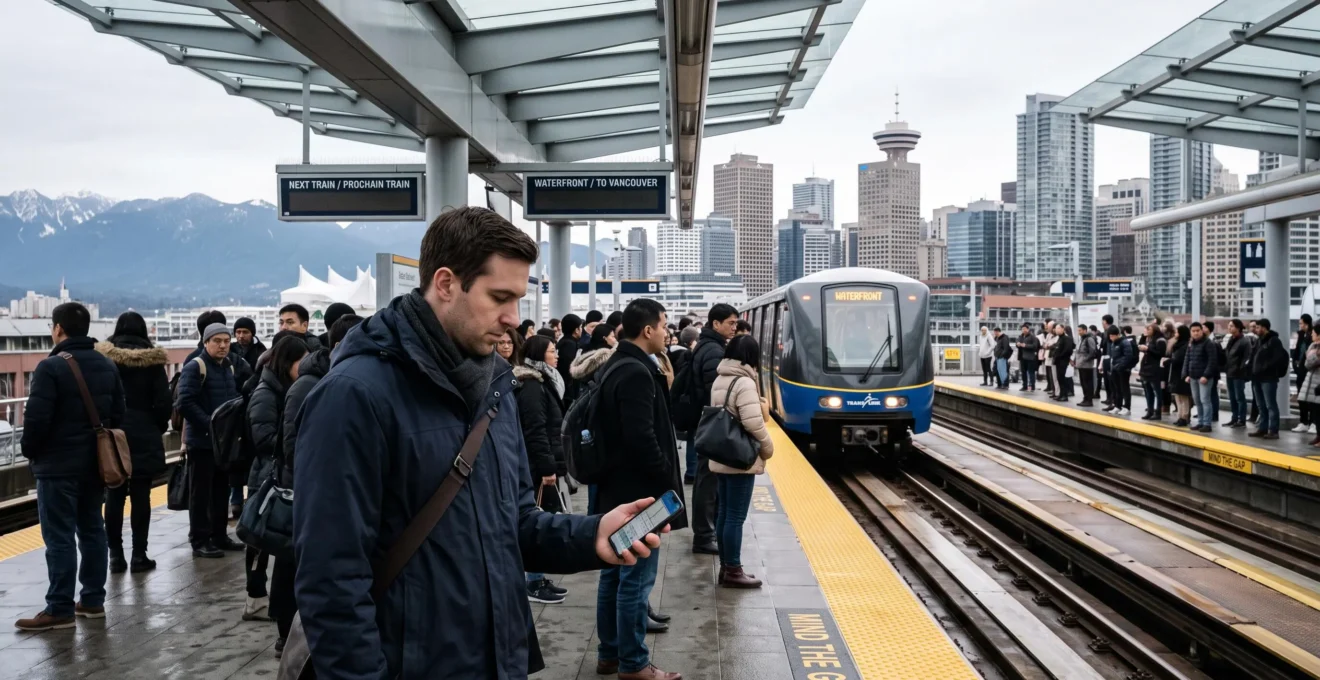
The best Metro Vancouver city for finding a job within a 45-minute commute depends less on municipal boundaries than on where your occupation is concentrated, which employers are hiring, and how reliably you can reach them. Downtown Vancouver may suit a finance professional, Richmond may offer relevant opportunities for an aviation or distribution worker, and Burnaby or Surrey may provide a better balance for someone targeting several employment centres.
A higher salary or a larger number of job postings does not automatically mean better employment prospects. Competition, shift schedules, transportation expenses and the journey from your actual home address can all change the calculation.
The practical approach is to define a realistic travel boundary, compare opportunities within it, and broaden the search only when application results justify doing so. A 45-minute target is a useful starting constraint, not a guarantee that every trip will take the same amount of time.
Metro Vancouver job search: the essentials
- Choose employment locations by occupation and verified commuting time, not by city reputation alone.
- Compare actual salary offers after transportation costs and unpaid travel time.
- Track application responses before expanding into less accessible municipalities or changing industries.
- Why Do Wages and Job Density Change So Much Between Vancouver and Surrey for the Same Role?
- How to Plan Your Metro Vancouver Job Search Around Transit Time in 3 Simple Steps
- Downtown or Richmond: Which Metro Vancouver Location Fits You If You Want More Interviews?
- The Location Story Mistake That Makes Metro Vancouver Employers Doubt You’ll Show Up
- When Should You Expand Beyond Vancouver in Your Job Search to Avoid a 3-Month Stall?
- Port Terminal or Inland Warehouse: Which Metro Vancouver Logistics Path Pays Off Faster?
- Why Does BC’s Labour Market Move Differently Than Ontario During Slowdowns?
- Why Do Job Postings in Metro Vancouver Drop 30% in Winter Even When Hiring Is Strong?
Why Do Wages and Job Density Change So Much Between Vancouver and Surrey for the Same Role?
Wages and job concentration can differ between Vancouver and Surrey because employers serve different industries, compete for different skills and recruit from different labour pools. Two positions with identical titles may therefore offer different compensation and career prospects. The meaningful comparison is between specific employers and occupations, not a presumed city-wide wage premium.
Downtown Vancouver provides a concentrated market for corporate services, finance, technology and professional occupations. Surrey offers a different combination of health care, retail, construction, distribution and other employment activities. These patterns influence how many relevant employers a worker can realistically approach and how much specialized experience they may require.
An occupational cluster premium describes a possible compensation advantage associated with employers concentrated around particular skills or industries. It is a useful analytical concept, but it is not a fixed percentage that can be applied to every Vancouver job. A specialized downtown employer might pay more for scarce expertise, while a Surrey employer could offer stronger compensation for a role with difficult shifts or specific qualifications.
Job density is also occupation-specific. For an office professional, several potential employers within walking distance of a SkyTrain station may represent a valuable employment cluster. For a warehouse worker, a larger industrial district with facilities spread across several kilometres may create substantial employment opportunities but require a car or additional bus connections.
Government wage information provides a starting benchmark. The Job Bank wage report for warehouse associates near Government of Canada Job Bank Vancouver records a median hourly wage of 28.89 CAD/hour for the Lower Mainland–Southwest economic region, using a 2024 regional estimate.
CAD 28.89/hour
Regional median wage estimate for warehouse associates in the Lower Mainland–Southwest, based on 2024 data. This is not a current offer or a Vancouver-versus-Surrey wage comparison.
Government of Canada Job Bank, occupational wage information.
To compare two offers, start with the posted hourly rate or annual compensation. Then account for paid working hours, benefits, commuting fares or fuel, parking and the time spent travelling. Housing costs matter when choosing where to live, but should not automatically be attributed to a particular job if the worker is not planning to move.
Consider a hypothetical choice between a better-paid role requiring substantially more travel and a slightly lower-paid position close to home. The first may win on gross income while the second leaves more usable income and personal time. The outcome depends on the actual offers, not the municipalities alone.
The strongest city choice is the one where your target occupation, realistic compensation and commuting constraints overlap. Establishing that overlap makes the next step—mapping travel times—much more effective.
How to Plan Your Metro Vancouver Job Search Around Transit Time in 3 Simple Steps
Build your Metro Vancouver job search around a 45-minute commute by checking actual routes at working hours, identifying reachable employment locations and prioritizing applications inside that boundary. Use door-to-door travel time rather than distance or municipality names. A reliable 40-minute journey may be preferable to an unpredictable route advertised as slightly shorter.
Begin with the transportation network. TransLink‘s official Metro Vancouver transit maps show SkyTrain, bus, SeaBus and West Coast Express connections across the region. The published network maps effective September 7, 2026, help identify plausible corridors, but they do not establish a universal 45-minute travel boundary.
Step 1: Map journeys before applying. Select your home address, a potential workplace address and the actual time you would need to arrive. For a conventional morning schedule, an 8:00 a.m. departure can serve as an initial test, but adjust the time for the employer’s shift. Include walking, transfers and waiting, not only time on a train or bus.
Step 2: Create a 45-minute reachable-area list. Rather than drawing a simple geographical circle, record the specific destinations that fit your travel limit. A rapid-transit corridor can make one relatively distant location easier to reach than an industrial facility situated much closer geographically.
Step 3: Sequence applications geographically. Start with employers whose workplaces fall inside the tested boundary. If suitable openings are scarce or response rates remain weak, expand to a second group of destinations that require slightly more travel but still fit your daily commitments.
Build a margin into the decision. Connections involving multiple transfers, bridge crossings or infrequent buses may be vulnerable to disruption. Test alternative departure times and check service alerts. If the commute is close to 45 minutes under ideal conditions, determine whether arriving consistently on time would remain realistic.
Build your commute-ready application shortlist
- Identify your target occupation and preferred work schedule; record both in a one-line search objective.
- Check at least five relevant workplace addresses at your intended commuting hour; save a route-and-duration table.
- Classify each address as within 45 minutes, borderline or beyond your feasible limit; produce a prioritized location list.
- Match current openings to the reachable locations; create an application tracker with employer, role, address and route.
- Verify your most promising journeys against schedules and possible disruptions; retain a realistic commuting statement for interviews.
A commute map becomes useful only when it guides applications. Once the reachable area is clear, comparing specific employment centres such as downtown Vancouver and Richmond becomes much more meaningful.
Downtown or Richmond: Which Metro Vancouver Location Fits You If You Want More Interviews?
Downtown Vancouver is generally a more relevant starting point for corporate, finance and many technology roles, while Richmond merits particular attention for aviation, logistics, manufacturing and distribution. Neither location guarantees more interviews. Your chances depend on occupational fit, required qualifications, competition and whether employers believe you can reliably meet their schedules.
Downtown employers commonly recruit through structured job postings and formal selection processes, particularly in professional services and office-based occupations. Richmond offers a different employer mix, including businesses associated with airport operations, industrial activity, wholesale distribution and food production.
Recruitment procedures vary within both locations. Some businesses recruit through staffing agencies or direct applications, while others use extensive online screening. Do not assume that every warehouse accepts walk-in applications or that every downtown position requires a lengthy interview process.
A useful comparison considers four dimensions rather than the total number of advertised vacancies.
| Decision factor | Downtown Vancouver | Richmond |
|---|---|---|
| Industry fit | Corporate services, finance, professional and technology roles | Aviation, distribution, logistics, manufacturing and food processing |
| Language requirements | Often tied to client communication, documentation and professional duties | Vary by employer, operational duties and workplace safety requirements |
| Recruitment routes | Formal postings, professional networks and company career portals | Company portals, staffing agencies and role-specific operational recruitment |
| Transit considerations | Strong central rapid-transit connectivity for many office locations | Canada Line access for some destinations; other workplaces need additional connections |
Commute reliability can matter during recruitment, especially for positions with fixed start times or early shifts. A candidate who can explain a practical route and demonstrate schedule compatibility can remove an uncertainty for the employer. That does not establish a universal hiring preference for local residents, and proximity should not be mistaken for proof of stronger qualifications.
Similarly, more downtown postings do not necessarily mean better interview odds. A smaller pool of highly relevant Richmond vacancies could produce more responses for someone with the right industrial experience. Actual applicant counts and interview rates would be needed to establish which market offers a statistical advantage.
Track results by location: applications submitted, employer responses and interviews obtained. If Richmond produces stronger responses for your qualifications, allocate more attention there while continuing to evaluate the commute.
The most promising location is not necessarily the one with the longest vacancy list. It is where relevant employers can see both a strong skills match and a practical working arrangement—two points that should also be clear in your application.
The Location Story Mistake That Makes Metro Vancouver Employers Doubt You’ll Show Up
The main location mistake is claiming that a distant workplace is easy to reach without checking the journey. For shift-based or time-sensitive positions, an unexplained commute can create questions about punctuality and availability. A credible location story identifies the actual route, realistic travel time and any arrangements needed to attend work consistently.
Imagine applying for an early-start position across the region while relying entirely on transit. Stating that transportation will not be a problem is less useful than confirming whether the required services operate before the shift begins. The key issue is not how enthusiastic the applicant sounds, but whether the proposed commute is feasible.
A practical explanation might be: « I’ve checked the journey from my home to your workplace for the scheduled start time. The route uses the Expo Line followed by a short walk, and I have allowed time for the connection. » Only use this wording if the route genuinely matches the workplace and schedule.
Where the journey is reliably within 45 minutes, a brief statement can address concerns without drawing unnecessary attention to your residential location. Where the trip is longer, explain what makes it sustainable: access to a vehicle, an achievable relocation plan, suitable shift arrangements or a confirmed hybrid schedule.
Do not promise relocation or flexibility that has not been arranged. A credible statement must survive follow-up questions about the first shift, late finishes and unexpected transportation disruptions.
For most applications, commuting details need not dominate the cover letter. Introduce them when the workplace is far from your stated location, the schedule makes transportation relevant or the employer specifically asks about availability.
Repeatedly applying for distant jobs that you could never accept wastes effort and may undermine confidence if an employer discovers the mismatch. There is no basis for assuming a region-wide employer reputation system, but consistency and credibility matter in individual recruitment processes.
A well-tested route can remove a practical objection, but it cannot compensate for missing qualifications. When suitable applications still produce few responses, the next decision is whether to change location, targeting or skills.
When Should You Expand Beyond Vancouver in Your Job Search to Avoid a 3-Month Stall?
Expand your Metro Vancouver job search when sustained application results show that your current geography is too restrictive, not automatically after three months. Low callback rates may justify testing additional employment centres, while interviews that repeatedly fail to produce offers point toward a different problem. The correct response depends on identifying where the recruitment process breaks down.
A search stall should be defined using evidence rather than elapsed time alone. Track suitable applications, employer responses, interviews and offers over comparable periods. A small number of applications may not reveal a meaningful pattern, especially in specialized occupations.
If few employers respond, review job fit, resume quality, required qualifications and geographical coverage. When those elements appear credible but openings remain limited, test additional municipalities. If applications generate interviews but no offers, examine interview preparation, skills evidence, compensation expectations and role alignment before simply travelling farther.
The expansion should be gradual. Burnaby and New Westminster may provide accessible alternatives for workers using rapid transit, depending on their starting address. Surrey, the Tri-Cities and Langley can broaden the employer mix, particularly for industries with activity outside the downtown core. Some Fraser Valley destinations may add substantial travel time or require a vehicle.
| Search area | Potential occupational focus | Commuting decision |
|---|---|---|
| Burnaby and New Westminster | Office services, retail, health care, commercial and industrial roles | Check proximity to rapid transit and the workplace’s actual address |
| Surrey | Health care, construction, services, distribution and retail | Account for travel beyond major transit stations |
| Tri-Cities | Services, commercial employers, trades and industrial roles | Check transfers and first- or last-mile access |
| Langley and the Fraser Valley | Warehousing, manufacturing, trades and related activities | Evaluate vehicle availability, shift times and total travel costs |
Expansion can also be industry-based. Someone with inventory, scheduling or customer-service skills may qualify for different employers without requiring an entirely new occupation. Testing adjacent roles within the existing commute boundary may deliver more relevant opportunities than widening the radius indiscriminately.
Choose one change at a time where practical. Compare response rates before and after adding a location or occupational category, while recognizing that differences may also reflect posting quality, seasonal demand and small sample sizes.
Moving beyond Vancouver should increase the number of realistic opportunities, not simply the distance you are willing to travel. This distinction becomes particularly important when considering logistics and port employment, where workplaces can be difficult to reach without a car.
Port Terminal or Inland Warehouse: Which Metro Vancouver Logistics Path Pays Off Faster?
Inland warehouse work may offer a more accessible first step for some applicants, while port-terminal careers can involve different entry requirements, recruitment structures and progression opportunities. Neither pathway is universally faster or better paid. Compare real vacancies, required credentials, available shifts and transportation before deciding which route is likely to produce your first paycheque sooner.
Port-related work spans several distinct occupations. Longshore workers, customs-related employees, terminal equipment operators and trucking personnel do not share one hiring process or pay structure. Port activity around Burrard Inlet and Roberts Bank also creates different commuting challenges from inland distribution facilities.
For someone entering logistics without specialized experience, inland warehousing may provide a wider range of roles worth investigating, including order picking, receiving, inventory handling and shipping support. However, the availability of entry-level vacancies and the speed of recruitment must be checked against current listings rather than assumed.
The WorkBC shippers and receivers career profile projects openings for shippers and receivers in the Mainland/Southwest region3,1202025–2035 across 2025–2035. This ten-year forecast is not a count of jobs currently available, nor does it show how quickly an individual employer will hire.
For comparison, WorkBC forecasts 1,070 longshore-worker openings in Mainland/Southwest during the same ten-year period. These figures concern different occupations and cannot establish that warehouses recruit more quickly or that port employers offer superior compensation.
Employment progression should be evaluated through actual role requirements. Equipment-operation training, workplace safety credentials and transportation-related certifications may be relevant to particular positions. Check whether the employer requires a qualification before hiring, provides training afterward or recognizes prior experience before paying for a course.
Transportation can outweigh a nominal pay advantage. Industrial workplaces may sit far from frequent transit routes, and shift times may fall outside convenient service hours. A candidate without a vehicle should verify the full route and alternative arrangements rather than assume that a facility within the metropolitan area is accessible.
Compare pathways using four questions: Which jobs match your current qualifications? Which employers are recruiting? What is the realistic time from application to paid work? Can you consistently reach the site for every scheduled shift?
For immediate income, prioritize reachable roles with realistic entry requirements. For long-term progression, examine documented training pathways and future responsibilities. The appropriate choice may also change as the provincial economy shifts.
Why Does BC’s Labour Market Move Differently Than Ontario During Slowdowns?
British Columbia and Ontario can experience economic slowdowns differently because their industries, trading relationships and employment structures are not identical. BC has substantial exposure to housing, construction, natural resources and Pacific trade, while Ontario has a larger manufacturing base. These differences can affect which jobs weaken or recover first, although no fixed provincial pattern predicts every downturn.
For Metro Vancouver workers, local industry conditions can matter more than national employment headlines. A slowdown affecting housing development may influence construction hiring and related suppliers. Changes in international trade can affect shipping and distribution, while professional services may respond to different business conditions.
Ontario’s manufacturing exposure creates another mix of risks, including industrial demand and supply-chain changes. This does not imply that either province is consistently more resilient. Both have diverse economies, and employment outcomes vary by occupation, location and the nature of each slowdown.
Geographical diversification within Metro Vancouver also has limits. If an industry contracts across the region, applying to equivalent employers in Burnaby, Surrey and Richmond may not materially improve the available opportunities. The same sector-wide constraints can affect all three employment markets.
Industry diversification can therefore be more valuable than geographical expansion when a slowdown is concentrated in the worker’s existing sector. A logistics professional, for example, could investigate transferable responsibilities in retail distribution, manufacturing supply chains or procurement support rather than searching only for the same warehouse position in another municipality.
Use current provincial labour market information and occupation-specific vacancies to evaluate conditions. Structural economic differences explain potential vulnerabilities but do not prove that a particular employer is hiring or that one province will recover ahead of another.
When the employment market becomes uneven, search strategies should respond to occupational evidence rather than broad headlines. Seasonal fluctuations in advertised vacancies require the same care, particularly during winter.
Key takeaways before interpreting winter hiring
- A lower number of job advertisements is not necessarily evidence of an equivalent decline in actual hiring.
- Seasonal patterns differ across construction, retail, logistics and professional occupations.
- Measure market conditions through relevant postings, employer responses and recruitment channels rather than one headline percentage.
Why Do Job Postings in Metro Vancouver Drop 30% in Winter Even When Hiring Is Strong?
Metro Vancouver job postings can decline during parts of winter because recruitment follows business budgets, holiday schedules and industry-specific seasonal demand. However, a 30% drop is not an established universal winter pattern. Advertising activity and actual hiring are different measures, so a reduction in online vacancies does not automatically mean employers have stopped recruiting.
Year-end hiring decisions can be affected by budget approvals, management availability and recruitment calendars. Certain organizations postpone advertising until new budgets are confirmed. Construction-related employment may also fluctuate with project schedules and weather-sensitive work, while retail and distribution recruitment can follow different holiday and inventory cycles.
Even within one industry, the seasonal pattern depends on the employer. A distribution facility preparing for holiday demand may recruit before winter peaks, whereas another operation could advertise fewer positions after temporary staffing requirements decline. Treating these situations as a single metropolitan hiring trend obscures the practical differences.
Public job boards also reveal only part of the market. Employers may recruit through staffing agencies, referrals, existing candidate pools or direct applications. These channels can remain active even when publicly advertised vacancies decrease, although their share of hiring cannot be inferred without supporting data.
To evaluate the suggested 30% decline, track the same occupation, geographic area, job boards and search filters over successive months. Record comparable posting counts and avoid mixing results from different platforms or duplicated advertisements. A change in search methodology can otherwise appear to be a market shift.
A useful winter strategy combines ongoing applications with preparation. Refresh role-specific resumes, identify relevant agencies, review genuine training requirements and reconnect with employers whose hiring processes remain active. Continue applying to suitable openings rather than waiting for an assumed spring recovery.
Measure results through employer responses as well as vacancy counts. If fewer postings still produce relevant interviews, your search may be functioning adequately. If both opportunities and responses weaken, consider expanding into adjacent occupations or newly reachable employment centres without abandoning your commute limit.
Choose your next action by reviewing recent applications, confirming the accessibility of promising employers and comparing actual vacancies across relevant industries. The best Metro Vancouver job location remains the one where your qualifications, hiring opportunities and sustainable commute meet—not the municipality with the most impressive headline statistics.
Can a 45-minute commute include more than one municipality?
Yes. A 45-minute commuting boundary can cross municipal borders, particularly along convenient rapid-transit connections. Its shape depends on your starting address, workplace destination, departure time and transportation mode. Check individual routes instead of assuming that every workplace within a municipality is equally accessible.
Should I include my home address on a Metro Vancouver resume?
A complete street address is generally unnecessary for demonstrating your suitability for a role. If location matters to the position, a broad municipality or availability statement may be more useful. Provide accurate commuting information when requested, especially for early shifts or workplaces with limited transit access.
How can I compare two jobs when one requires driving and the other is accessible by SkyTrain?
Compare take-home compensation, transportation expenses, travel time, scheduling and benefits. For driving, account for fuel, parking and relevant vehicle costs; for transit, consider fares, transfers and service availability. Separately evaluate the personal value of the additional commuting time rather than treating it as an automatic deduction from wages.
Are WorkBC job forecasts the same as available job openings?
No. WorkBC’s 2025–2035 occupational projections estimate openings over a ten-year period and are not inventories of positions currently being advertised. Use forecasts to understand longer-term occupational demand, then consult recent employer listings to identify actual applications worth pursuing.
What if the best-paying offer is outside my 45-minute commuting limit?
Calculate the compensation difference after commuting expenses, then assess the extra travel time, route reliability and working schedule. Consider whether relocation, a different shift or an approved hybrid arrangement would make the job sustainable. Accept a longer commute only when its full implications are manageable, rather than relying on the salary difference alone.