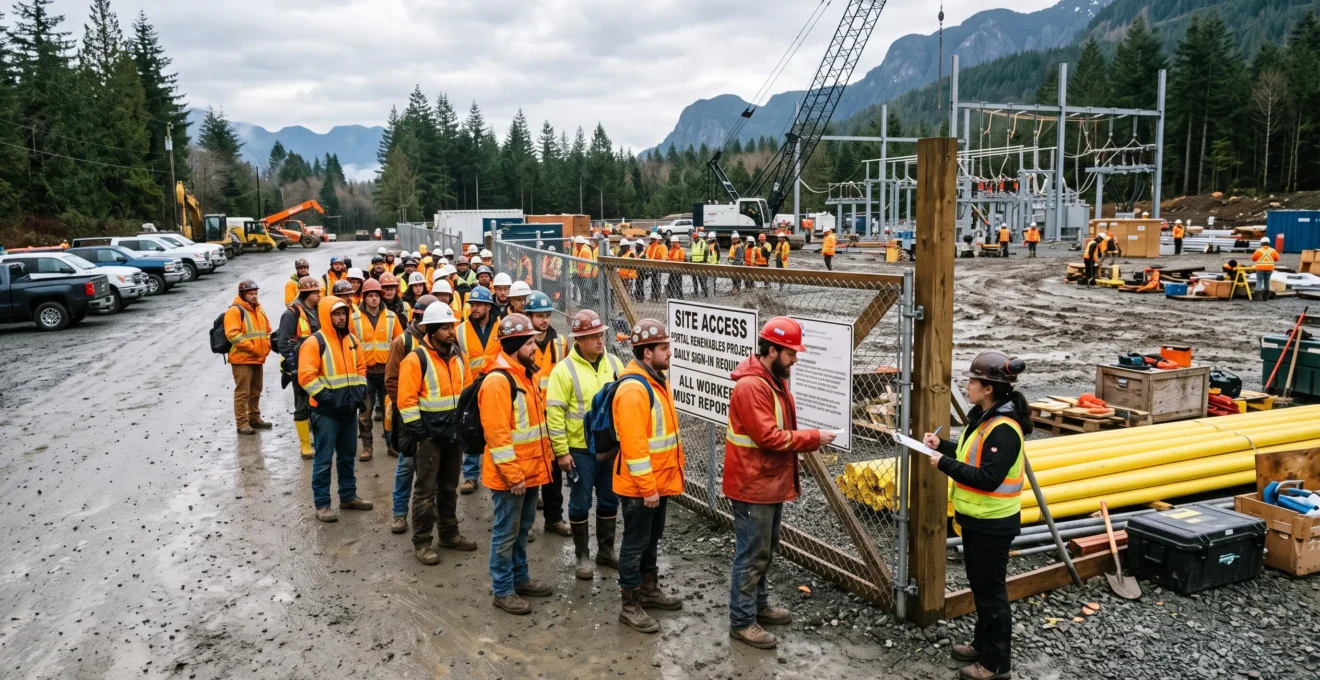
Getting hired on renewable infrastructure projects near Vancouver is less about knowing the right person and more about identifying which companies are attached to a project, understanding when they are likely to need people, and applying through the correct channel. A renewable energy development can involve an owner or developer, engineering and construction firms, specialist subcontractors, suppliers and several layers of project support. A job seeker who watches only public job boards can miss opportunities that become visible through procurement announcements, contractor career pages, union dispatch systems or specialist recruiters.
The practical approach is to work backwards from projects rather than forwards from job titles. Identify developments in British Columbia, determine their current phase, map the companies involved, and match your experience to roles those companies actually perform. Then prepare for the relevant hiring window rather than sending the same application to every employer at once.
This method can help both experienced construction professionals and people changing careers from Vancouver’s technology, finance, engineering or administrative sectors. It cannot guarantee an interview: funding, permits, project schedules, qualifications and employer decisions all affect recruitment. Its advantage is that it makes the search more targeted, measurable and easier to adjust when new project information appears.
The practical route into renewable infrastructure work
- Track project announcements, procurement activity and regulatory milestones to identify developments that may need additional staff.
- Build a ranked list of 25 contractors and subcontractors, then check each company’s actual recruitment channel and role requirements.
- Choose a realistic entry path, prepare relevant safety and professional documents, and align applications with project timing.
- Why Do Renewable Infrastructure Projects Near Vancouver Hire in Sudden Waves?
- How to Build a Target List of 25 Contractors for Vancouver Renewable Projects in 1 Hour?
- Field Role or Project Controls: Which Renewable Infrastructure Path Near Vancouver Fits You Best?
- The Safety-Readiness Mistake That Gets Applicants Rejected for BC Renewable Project Sites
- When Should You Apply for Renewable Infrastructure Work Near Vancouver to Catch Mobilization Hiring?
- Why Do Vancouver CleanTech Teams Hire Differently Than SaaS Teams for the Same Skills?
- (b): How to Build a Target List of 25 Contractors for Vancouver Renewable Projects in 1 Hour? — Prioritizing and Activating the List
- Which CleanTech Roles in Vancouver Hire Fastest When You’re Switching Careers?
Why Do Renewable Infrastructure Projects Near Vancouver Hire in Sudden Waves?
Renewable infrastructure projects near Vancouver often create concentrated hiring needs because their work is organized around project milestones rather than continuous product delivery. When a development advances from planning and permitting into procurement, site preparation or construction, the companies responsible for delivery may need additional field personnel, project coordinators, schedulers and document-control support. The timing and size of each hiring wave depend on the individual project’s funding, approvals, procurement decisions and construction schedule; no single hiring calendar applies to every development.
The distinction between owner-side and contractor-side recruitment matters. Utilities, project developers and project partners may recruit for development, commercial management, engineering and oversight. Engineering, procurement and construction (EPC) contractors and their subcontractors may separately recruit the people needed to execute packages of work. A vacancy posted by an owner therefore does not necessarily reveal all the employment opportunities associated with the same development.
To spot potential activity, monitor public procurement information, project award announcements and relevant regulatory milestones. BC Hydro‘s supplier opportunities and procurement information is one useful starting point for understanding the organization’s purchasing and contracting environment. The British Columbia Environmental Assessment Office also publishes project notifications, which can help establish whether a development is progressing through an environmental assessment process. A notification is a research signal, not proof that a contractor is hiring.
Applications sent between project milestones may remain on file without matching an active vacancy. That does not automatically mean the candidate is unsuitable; the employer may simply have no current requirement for that role. Record the date of each application and the project stage so that follow-up is based on new information rather than repeated messages sent without a reason.
The important shift is to interpret silence in context. Project timing cannot replace qualification requirements or direct confirmation from an employer, but it can help determine when a targeted application is worth making.
How to Build a Target List of 25 Contractors for Vancouver Renewable Projects in 1 Hour?
You can build an initial list of 25 potential employers in one focused hour by starting with identifiable projects, tracing the companies connected to them, and ranking those companies by fit. Treat the hour as a structured research sprint, not as a promise that every company is currently hiring. The final list should identify both a plausible connection to renewable infrastructure and a practical way to check for suitable work.
Begin with public project announcements, procurement information, project registries and relevant permit or assessment records. For every promising development, record the project name, location, technology, apparent stage and the date of the evidence you found. Then look for disclosed developers, engineering firms, EPC contractors, civil contractors, electrical specialists, logistics providers and other suppliers. Distinguish confirmed project relationships from possible leads: a business operating in the energy sector is not necessarily contracted to a specific development.
Use three filters to rank the results. First, assess the project-phase fit: does the project appear to be planning, preparing for construction or executing work? Second, check the role fit: does the company appear to perform the type of work your background supports? Third, verify the recruitment route: company career page, union hall or dispatch system, staffing agency, or another route stated by the employer. These filters help prioritize realistic access over brand recognition.
BC Hydro’s information on independent power producer projects can help researchers understand the relationship between the organization and independent energy developers. Use such institutional sources to identify relevant project participants or mechanisms, then check the specific companies’ own information for current contracts and vacancies.
A simple spreadsheet is enough. Include the company, associated project, evidence URL, evidence date, project phase, likely role families, recruitment channel, qualification gaps and next action. Give each prospect a clear status such as confirmed connection, plausible lead or unverified. Do not label an employer an active project contractor unless the available evidence supports it.
Build a contractor shortlist you can act on
- Identify three to five relevant renewable infrastructure projects and record the public page supporting each lead.
- Extract named developers, contractors and disclosed suppliers into a working spreadsheet, marking unverified connections clearly.
- For each company, record the project phase and the type of work it appears to perform.
- Check the company’s own career page and any employer-identified union, dispatch or staffing route; save the applicable URL.
- Rank 25 targets by role fit and evidence quality, then assign each a dated next action such as checking a vacancy, verifying a requirement or making a tailored application.
A carefully qualified list is more useful than an unfiltered directory. Revisit it when projects advance or new information appears, and remove or downgrade leads that cannot be substantiated.
Field Role or Project Controls: Which Renewable Infrastructure Path Near Vancouver Fits You Best?
The better starting point depends on whether you want to work directly at a project site or help control its schedule, cost, records and coordination. Field work can involve site operations, trades, installation or commissioning, while project-controls and support work can include planning, cost tracking, document control and reporting. Neither route is universally better: the right choice depends on your existing credentials, travel tolerance, working preferences and the responsibilities employers actually advertise.
| Criterion | Field-oriented roles | Project-controls and support roles |
|---|---|---|
| Typical work | Site execution, inspections, installation support, testing or commissioning, depending on the role | Schedules, cost information, reporting, document registers and coordination |
| Location | Assigned construction or operating sites, which may be outside Metro Vancouver | Project offices, site offices or hybrid arrangements where the employer permits them |
| Entry requirements | Role-specific training, safety requirements and, for regulated or skilled work, relevant credentials | Organization, reporting, planning, software and subject-matter skills; technical roles may require formal qualifications |
| Work pattern | May involve early starts, travel, site schedules or rotations | May follow office or project reporting cycles, with deadlines tied to construction milestones |
| Career evidence | Demonstrated site competence, safe work practices and applicable trade or technical credentials | Accurate reporting, schedule or cost contributions, document quality and reliable coordination |
People moving from office-based careers may find project coordination, document control or project reporting a more direct starting point. Engineering, logistics, finance and administration experience can be valuable when translated into infrastructure language. Explain the scale of budgets or schedules supported, the records maintained, the dependencies coordinated and the procedures followed. Avoid presenting general office experience as a substitute for a technical licence or site qualification.
Field roles can suit candidates who prefer practical work and can meet the position’s site, physical and travel expectations. Some skilled trades or engineering responsibilities require specific credentials or professional registration. Confirm those requirements against the actual vacancy and the relevant authority; do not assume every job bearing the same title has identical prerequisites.
Compensation and lifestyle must be evaluated together. Certain site positions may offer overtime, travel allowances or rotation-related arrangements, but these are employer- and contract-dependent, not guaranteed features of field work. Office-based roles may provide greater geographic stability, but they can also be tied to deadlines and project duration.
Before committing to either path, consider three questions: Can you travel to the likely worksite? Do you enjoy daily site-based safety and operational requirements? Would your current experience be more immediately useful in planning and coordination? Use your answers to choose vacancies with a credible fit rather than applying indiscriminately across both routes.
The strongest choice is the one that combines realistic entry requirements with work you can sustain and skills that move you toward your longer-term objective.
The Safety-Readiness Mistake That Gets Applicants Rejected for BC Renewable Project Sites
A common preparation mistake is assuming that safety credentials and site onboarding can be sorted out after an offer. Employers may need to verify relevant training, qualifications, fitness for the assigned work where applicable, and site-specific requirements before allowing a person to work. Missing or expired documentation can therefore delay an application or prevent site access even when the candidate’s technical experience looks promising. The precise requirements depend on the role, employer, worksite hazards and applicable rules.
British Columbia does not have one universal credential checklist that automatically qualifies every applicant for every renewable infrastructure site. Requirements that arise from legislation or occupational health and safety rules must be distinguished from training standards, employer policies, client requirements and project-specific orientations. First aid, WHMIS-related training and site orientation may be relevant in some settings, but a job seeker should not assume that one named card is always mandatory, accepted everywhere or sufficient by itself.
Read the vacancy and onboarding instructions carefully. If a posting mentions first aid, hazardous-materials training, trade qualifications, a driver’s licence or other requirements, record the exact wording and validity expectations. Ask the employer or its designated onboarding contact which credentials are required before interview, before site access or only for particular tasks. Where the employer provides training, confirm that before purchasing a duplicate course. For legal requirements, check the relevant official guidance rather than relying on an informal list shared by another applicant.
A current record of qualifications is useful even if no particular certificate is required for every application. Keep copies of credentials, completion dates and expiry dates in an organized folder. Distinguish completed training from courses booked or planned, and never state that a qualification is current when it has expired or has not yet been obtained.
Use a simple verification sequence for every target employer:
- Read the current job description and copy its stated qualifications into your notes.
- Check the validity and expiry dates of relevant credentials you already hold.
- Confirm which credentials are required for the role and when they must be provided.
- Ask whether a course or orientation is employer-provided before paying for it yourself.
- Keep a copy of the employer’s confirmation so that your application and preparation remain consistent.
Preparation should reduce avoidable delays, not encourage unnecessary spending. Verify requirements at the source, maintain accurate records, and prioritize the qualifications genuinely needed for the work you seek.
When Should You Apply for Renewable Infrastructure Work Near Vancouver to Catch Mobilization Hiring?
The most useful time to apply is when a credible project signal aligns with a role that the employer is likely to need. Rather than assuming that renewable infrastructure hiring follows a fixed season, monitor observable developments such as procurement announcements, project awards, relevant permit milestones and signs of site preparation. These signals can help prioritize research, but none proves by itself that a vacancy exists or that a project will mobilize on a particular date.
Think of a project as having three broad recruitment windows. Before mobilization, developers and delivery teams may need planning, engineering, commercial, procurement or project-management capacity. As work ramps up, contractors may require more site personnel, coordination support and logistics resources. During steady execution, recruitment may focus on replacement needs or particular technical skills. These are planning patterns, not guaranteed stages: project procurement, funding, approvals and construction sequencing vary.
BC Hydro’s announcements concerning electricity purchase agreements for renewable energy projects illustrate how institutional procurement decisions can provide evidence about developments in the energy sector. An award or agreement is a reason to investigate the project and its delivery participants; it is not evidence that a particular contractor has opened a position. Check the announcement’s scope and date, then seek current information from the companies involved.
Use a simple project-monitoring log with the milestone, source URL, publication date, company associated with the development, role family potentially relevant to your background and the next review date. Reassess the list whenever fresh evidence appears. If a project remains at an early regulatory stage, consider whether an owner-side role is relevant but do not assume field-contractor positions already exist. If execution appears nearer, review contractor vacancies and recruitment channels more frequently.
Maintain readiness between hiring windows. Keep your résumé tailored to the role, references accessible, qualifications current where required and work-location preferences clear. Be prepared to respond quickly if a suitable vacancy appears, without bypassing the normal selection process or claiming credentials you do not hold.
Timing improves the relevance of your search, not its certainty. Combine project monitoring with vacancy verification, and keep applying to genuine matches rather than waiting for every signal to align perfectly.
Key takeaways
- Renewable infrastructure recruitment is tied to project scope, approvals, contracts and delivery needs; a milestone is an indicator to investigate, not a hiring guarantee.
- Skills transfer is strongest when your résumé describes measurable delivery, coordination, budget, schedule and compliance experience in terms that fit the target role.
- Choose an entry position that builds relevant experience for your destination role, rather than selecting solely on the basis of which vacancy appears first.
Why Do Vancouver CleanTech Teams Hire Differently Than SaaS Teams for the Same Skills?
CleanTech and infrastructure employers often evaluate candidates against project delivery, technical requirements, safety and regulatory constraints, while a SaaS employer may focus more heavily on product development, recurring releases and commercial growth. The distinction is not absolute, but it matters when a Vancouver professional tries to transfer skills from software or another office-based industry into renewable infrastructure. Similar job titles can hide different evidence requirements and different consequences for mistakes.
A project manager moving from SaaS, for example, may already understand budgets, dependencies, schedules, stakeholder communication and risk registers. Those capabilities are relevant to infrastructure. The résumé should show how they were used: the size or complexity of projects supported, schedule commitments managed, suppliers coordinated, records maintained and issues escalated. Software delivery metrics can stay where they add value, but they should not be the only evidence presented for a role built around physical assets, approvals and site delivery.
Technical and safety evidence can also carry a different weight. An infrastructure vacancy may require an applicable trade credential, professional registration, site experience or a specified training record. Familiarity with planning software or a strong online portfolio does not automatically replace those requirements. Conversely, office-based roles in document control, project coordination, reporting, procurement support or cost analysis may place significant value on transferable organizational and analytical skills.
CleanTech itself is not one employer category. A software company developing energy-management products, an equipment manufacturer, an engineering consultant, a renewable project developer and a construction contractor can all operate within the broader sector while using different recruiting criteria. Read the responsibilities and mandatory qualifications rather than inferring the hiring process from the company’s environmental mission or industry label.
To test your fit, select three current vacancies representing the role you want. Highlight the responsibilities you can already demonstrate, the requirements you can verify and the gaps needing training or experience. Adapt your résumé around that comparison. This process produces a more credible application than relabelling every previous position as CleanTech experience.
The objective is not to disguise a different career history. It is to show employers exactly which capabilities transfer, what evidence supports them and where additional qualifications would be necessary.
(b): How to Build a Target List of 25 Contractors for Vancouver Renewable Projects in 1 Hour? — Prioritizing and Activating the List
A contractor list creates value only when it changes how you spend your time. After identifying 25 prospects, sequence your outreach according to the evidence for each project, your role fit and the employer’s stated hiring route. Applying to all 25 on the same day may be less effective than contacting a smaller group whose work and current requirements match your experience, while monitoring the remainder for meaningful updates.
Divide the list into three working tiers. Put the strongest verified matches first: contractors with a supported project connection, a plausible need for your role and a visible recruitment channel. Put credible but less immediate prospects in a second tier for periodic checks. Keep companies whose project relationship or fit remains uncertain in a research tier until better evidence appears. These are personal prioritization categories, not a claim that any employer has a vacancy.
Use each company’s own instructions to choose the next step. A direct application may be appropriate where a relevant job is posted. For positions typically filled through a union hall or dispatch system, verify the applicable route and eligibility rather than assuming a direct résumé submission is sufficient. Specialist staffing agencies may be relevant for some industrial or energy placements, but confirm the agency’s actual sector focus and the role it is recruiting for. Industry associations can help identify companies and professional contacts; membership alone does not establish access to a job.
Make outreach specific and evidence-led. Refer to the relevant project or work package only when the relationship is publicly supported. State the role you are seeking, the qualifications you can verify, and the experience most relevant to the employer’s work. A question about the correct recruitment channel or a published role’s required credentials is more actionable than a generic request for any available job.
Maintain a contact log with the company, project evidence, vacancy or channel, date applied, response, confirmed requirements, expected follow-up date and next action. Record estimates as estimates and distinguish employer-confirmed information from your interpretation. When a company confirms a future staffing window, note who provided the information and when it should be rechecked; do not treat an informal indication as a guarantee.
Reallocate effort as evidence changes. A previously uncertain prospect can move up when its role fit or recruitment route becomes clear, while an unresponsive or unsupported lead can move down. Over time, the list becomes a practical record of where your experience has the strongest chance of matching a genuine need.
Which CleanTech Roles in Vancouver Hire Fastest When You’re Switching Careers?
For a career switcher, the most realistic first step is often a support role whose stated requirements match existing skills, rather than an immediate move into a regulated trade or specialist engineering position. Document control, site administration, project coordination support and logistics are role families worth investigating because infrastructure projects need records, communication and operational organization. They are not guaranteed to be the fastest-hiring roles in Vancouver, and actual entry barriers and vacancies vary by employer and project.
Document control may suit people who are organized, accurate and comfortable maintaining registers, revisions, transmittals and controlled project records. Site administration can draw on scheduling, communication, purchasing or recordkeeping experience, although some positions require regular attendance at a construction site. Project coordination support may fit candidates who have managed dependencies, meeting actions, status reports and supplier communication. Warehouse or logistics roles may be appropriate for applicants with inventory, dispatch, procurement or transport experience, subject to the role’s own site and physical requirements.
Higher-barrier roles need separate planning. Electrical trades positions may require the relevant apprenticeship, certification or other credentials for the work involved. Professional engineering responsibilities may require appropriate registration, depending on the position and applicable rules. Commissioning roles can also demand specialized technical experience. A short résumé rewrite cannot replace these qualifications; verify the precise requirements before investing in an application or training path.
Choose a first role for its connection to the next one. Someone who wants to move into project controls should look for support work that provides exposure to schedules, cost reporting, document registers or project systems. A candidate aiming for field operations should prioritize legitimate opportunities that build relevant site experience and a record of following safety procedures. An entry-level administrative position unrelated to the intended destination may generate income but offer fewer opportunities to build the evidence needed for a later move.
Once employed, use each assignment to document contributions accurately: the process you improved, the records you maintained, the reports you prepared or the coordination work you completed. Seek feedback and development opportunities through the employer’s normal channels. Progress depends on performance, available openings, qualifications and project requirements; an initial contract is a possible stepping stone, not a promise of promotion.
The best first move is the one that is both attainable now and relevant to the work you want next. Before applying, verify the vacancy, map each essential requirement to evidence in your experience, and identify the remaining gaps honestly.
Can I get a renewable infrastructure job near Vancouver without industry contacts?
Yes, it is possible to search without an established contractor network. Start with identifiable projects and public procurement or regulatory information, trace disclosed contractors and suppliers, and use the recruitment channel each employer specifies. A structured search can improve targeting, but it cannot guarantee an interview or replace required qualifications.
Where should I look for renewable infrastructure project leads in British Columbia?
Use institutional procurement information, project announcements, relevant environmental assessment notifications and the career pages of companies tied to projects. Confirm dates and project relationships, and distinguish a development announcement from evidence of an active vacancy. BC Hydro and the provincial Environmental Assessment Office are useful starting points for the specific information they publish.
Do I need first aid and WHMIS training before applying for a construction site job?
Not every role has the same prerequisites. Requirements depend on the work, hazards, employer and site. Read the current job description and onboarding instructions, verify any applicable legal obligations through official guidance, and ask the employer which credentials must be current before interview or site access. Do not assume a particular card is universally required or accepted.
Can SaaS project-management experience transfer to CleanTech or renewable infrastructure?
It can transfer to suitable planning, coordination, reporting and administrative roles when the application demonstrates relevant experience. Describe schedules managed, budgets supported, dependencies coordinated, supplier communication and records maintained. Then identify role-specific gaps, such as site experience, technical credentials or professional registration, instead of assuming the industries use identical hiring criteria.
How many contractors should I contact at once?
There is no universal optimal number. A list of 25 prospects can support research and prioritization, but begin with the strongest verified matches and follow each employer’s application instructions. Track dates, responses, confirmed requirements and next steps, then adjust the priority of each prospect when credible new information appears.